

USTR proposed tariffs of 15–35% on 14 economies instead of 16; No decision made on Mexico and Norway
Vietnam is highest at 35%, above China at 20%.
These targets supplied about 81% of U.S. consumer-goods imports, $410 billion, Jan.–Sep. 2026.
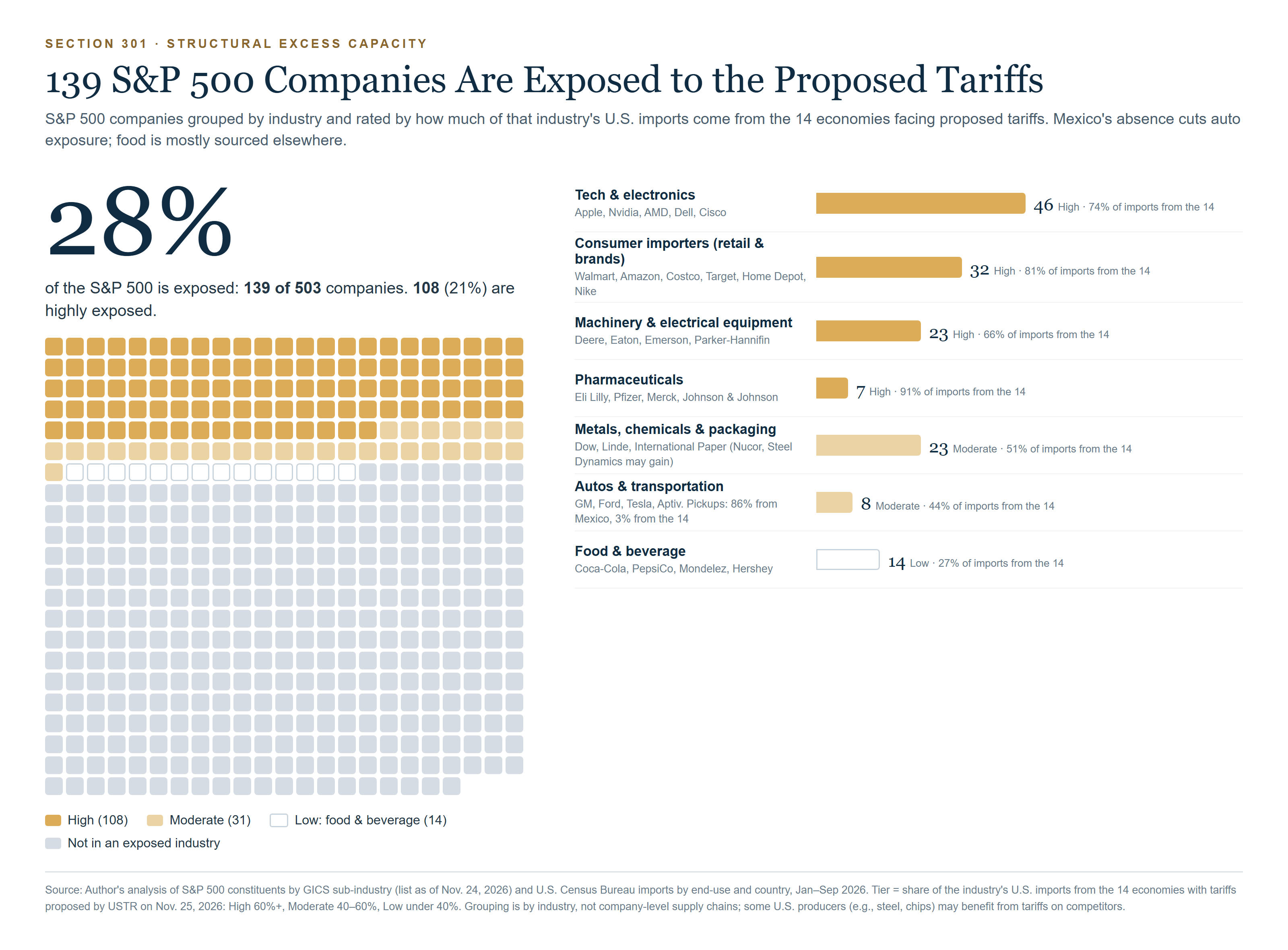
139 S&P 500 companies are exposed, including Apple, Nvidia and Walmart.
**updated- For most trading partners, USTR's new excess-capacity tariffs work as a top-up, not a stack, lifting rates only a few points to the 15–20% levels already set in their trade deals. China is the exception, with the new 20% layered on top of its existing first-term 301 tariffs of roughly 25%.
As expected, the United States Trade Representative released their findings on the Section 301 Tariffs on excess manufacturing.
There is a slight difference from what was proposed; 14 out of 16 countries have been targeted.
USTR said it "has not made determinations with respect to Mexico or Norway at this time," but you and I know that could change quickly depending on President Trump's mood.
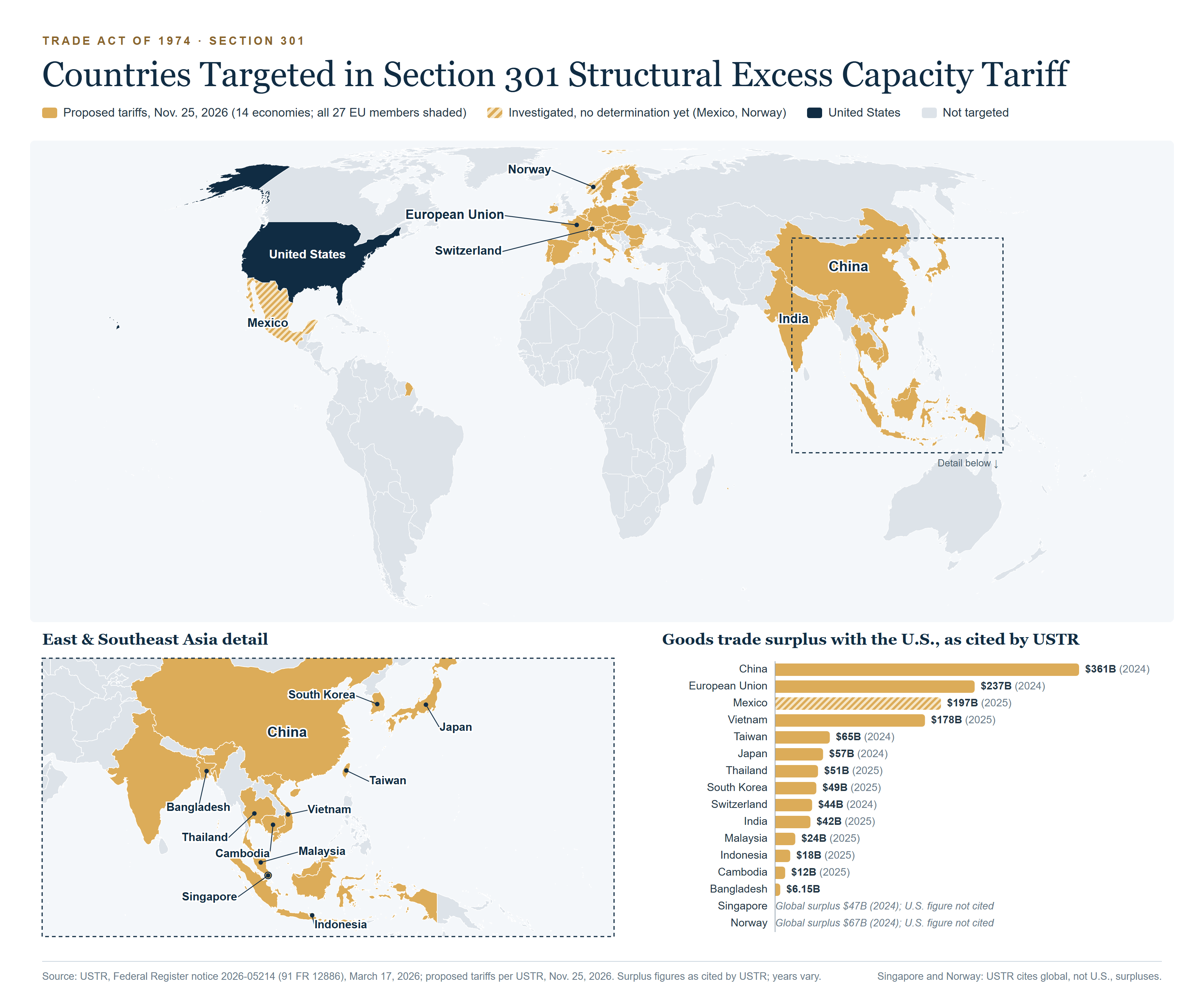
Because of the omission of Mexico, the United States’ largest trading partner and a key country in the supply chain of U.S. automobiles, the impact on consumer goods and stocks is slightly lower than I projected yesterday.
Instead of 9 out of 10 dollars smacked with tariffs, it has now been kicked down to 8 out of 10. That’s 81% of U.S. consumer goods imported between January and September this year, according to the U.S. Census Bureau data.
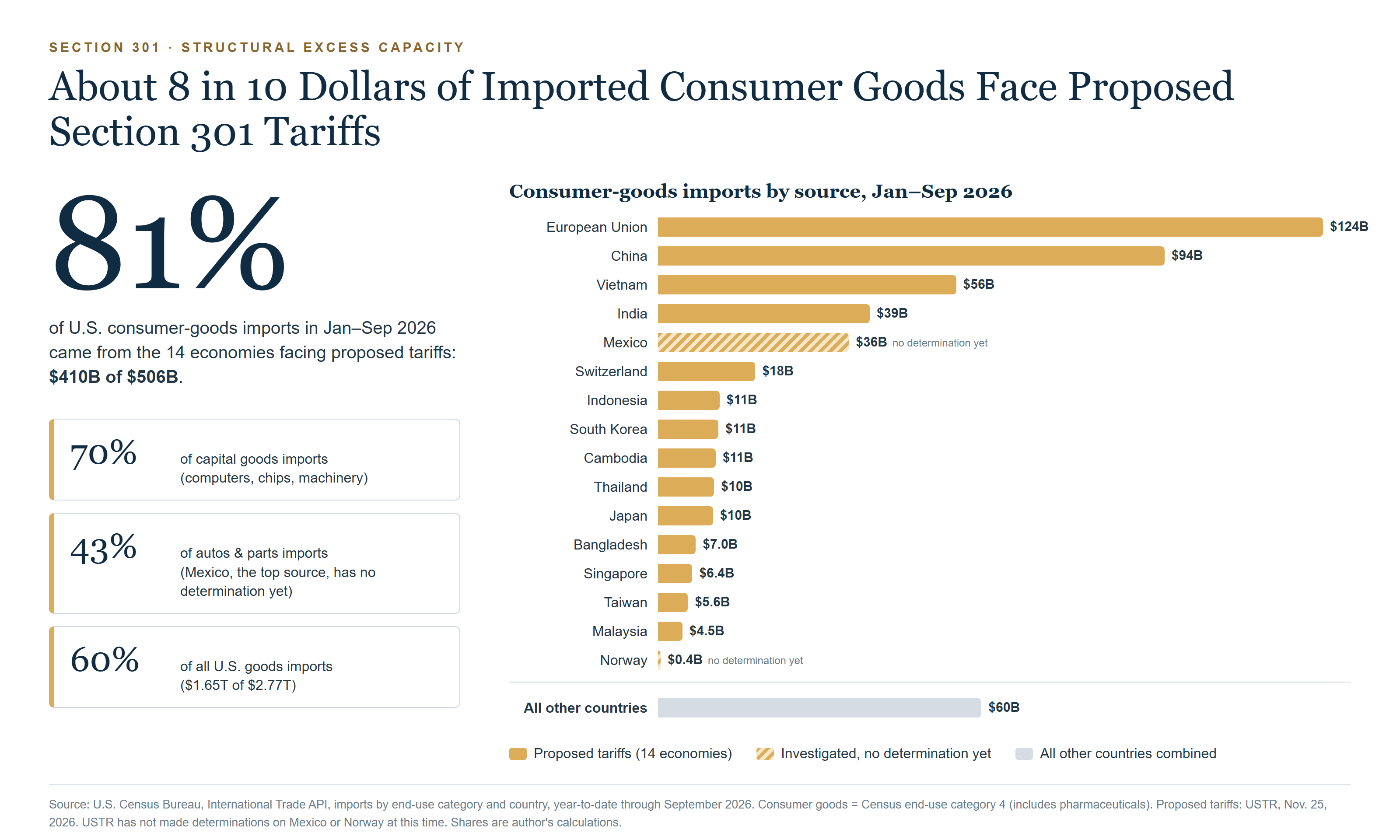
This shows you the enormity of trade with Mexico based on the value of goods.
Why Mexico Could Be Back on the List
Mexico is off the list for now, but I would not be surprised by political threats in the future. The latest news about Mexico and China’s trade relationship may fuel future bluster. An agreement to create a working group to promote trade emerged from Asia at the APEC summit.
Economy ministers Marcelo Ebrard of Mexico and Wang Wentao of China announced the initiative on Monday. President Claudia Sheinbaum Pardo announced Monday that the initial cooperation agreement reached a deal to create Mexico’s first smart hospital based on China’s medical training and scientific research.
Trump doesn’t like it when other countries start expanding their trade relationships. We have seen this with Canada in recent days, as the country has struck deals with China and increased trade relations with the European Union.
Stock Market Exposure
About 28% of the S&P 500, or 139 companies, are exposed to the proposed tariffs. Out of those, 108 are highly exposed, led by tech, retailers and consumer brands, pharma, and machinery. The original estimate with 16 countries was 153 companies, or 30% of the S&P 500.
Detroit dodged the worst for now. Pickups mostly come from Mexico, and USTR hasn't decided on Mexico yet.
Here’s how the Mexico omission helped the auto sector.
Pickups and heavy trucks: 86% come from Mexico and only 3% from the 14. Detroit’s most profitable vehicles are largely outside the tariffs for now.
Auto parts: 44% from Mexico, 40% from the 14.
But the industry is not 100% unscathed. Around 60% of passenger cars still come from the 14 countries hit under this tariff (Japan, Korea, and the EU).
Section 301 Tariff Breakdown
Trade deals are negotiations. This breakdown of the tariff scale is based on whether the country strikes a “deal” or not.
Each economy has its own proposed rate: Vietnam up to 35%, India 25%, and China 20%, according to USTR. Vietnam’s rate could drop to 20% and India’s to 17% if they reach trade agreements with the U.S. Singapore’s could drop from 20% to 10%.
This chart shows the negotiation/business-transaction mindset of the Trump Administration.
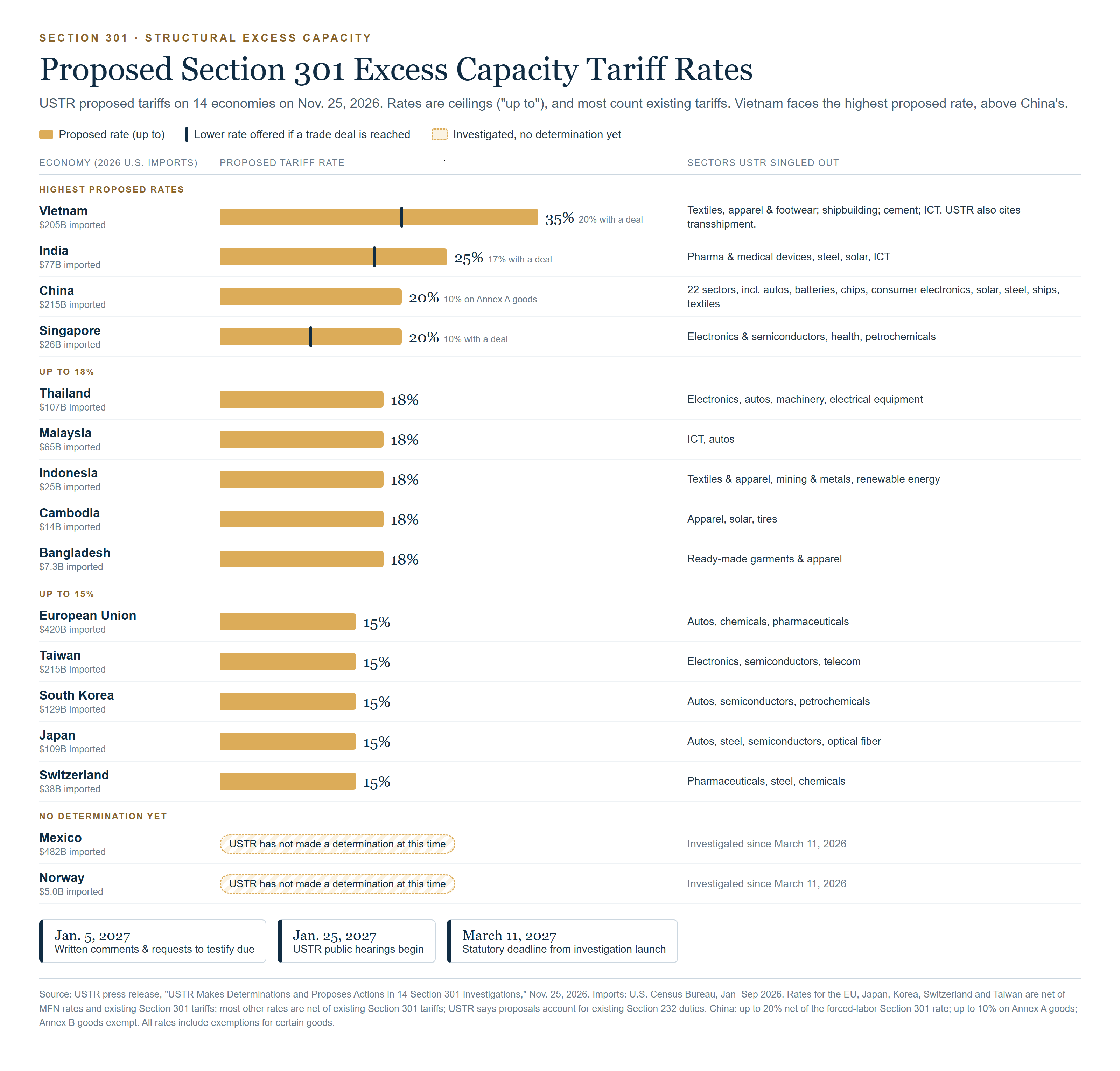
But as with all things in trade deals, there are caveats. China’s rate could increase if President Donald Trump feels China is honoring their promises.
January could be a make-or-break month for U.S.-China trade. On Jan. 9 and 10, four parts of the trade truce expire: Section 301 tariff exclusions, the pause on port fees for Chinese ships, the pause on U.S. export restrictions for affiliates of blacklisted Chinese companies, and China’s suspension of rare earth export controls.
Comments are due January 5, 2027, and hearings begin January 25. You can expect a deluge of letters to the USTR this holiday season.
In the meantime, companies will continue to frontload their products to get ahead of additional tariffs. This will further exacerbate congestion at the rails on the West Coast, but that is a story for another day.