

U.S. Treasury announced a list of key Iranian-linked logistics trade in its latest actions against IRan.
Iran Khodro (IKCO) and SAIPA together hold over 90% of Iran’s domestic car market. IKCO is the largest automaker.
Iran’s trade which fuels its economy is moved by truck.
The United States Department of Treasury has announced sanctions on Iran's railway companies and its largest truck maker to choke off trade and its economy.
Sanctions also targeting companies involved in the transport networks that keep the Iranian economy moving—from automotive parts to rail freight, steel trading and international payments.
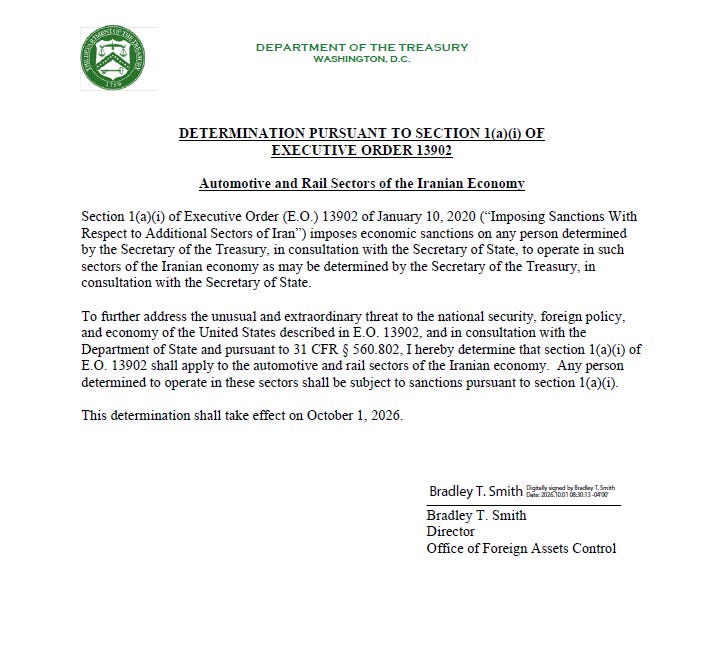
This latest sanctions annoucement is a part of Trump Administration’s “Operation Economic Outcast” designed to crush Iran’s economy. The October 1 sanctions action reaches beyond individual manufacturers to the suppliers, freight operators and financial networks supporting Iranian trade.
Why Iran’s Trucking and Rail Networks Matter
Before the war, Iranian transport officials said Iran's ports handled about 235 million tons a year, almost all port activity concentrating in the south.
There's no official 2026 port tonnage, but reports estimate oil shipments are down close to 90% and the main container port, Port of Shahid Rajaee, is largely idle.
Iran is overwhelmingly a trucking economy.
Jafar Jamili, head of Iran’s Ministry of Roads and Urban Development said around 88% of freight is moved by road.
The highly targeted sanctions on truck manufacturers and auto parts suppliers will trickle down to the companies that build and maintain freight vehicles.
Sanctions targeting railway operators will reach another part of Iran’s domestic and international logistics network.
At an August press conference IRNA, Sobhan Nazari said rail carries around 8% of Iran’s frieght. On the rails during the fiscal year ending March 2026, the Islamic Republic of Iran Railways (RAI) transported 44 million tons of total domestic and international freight, up from 40 million tons the previous year.
Alternative Trade Routes Around the Strait of Hormuz
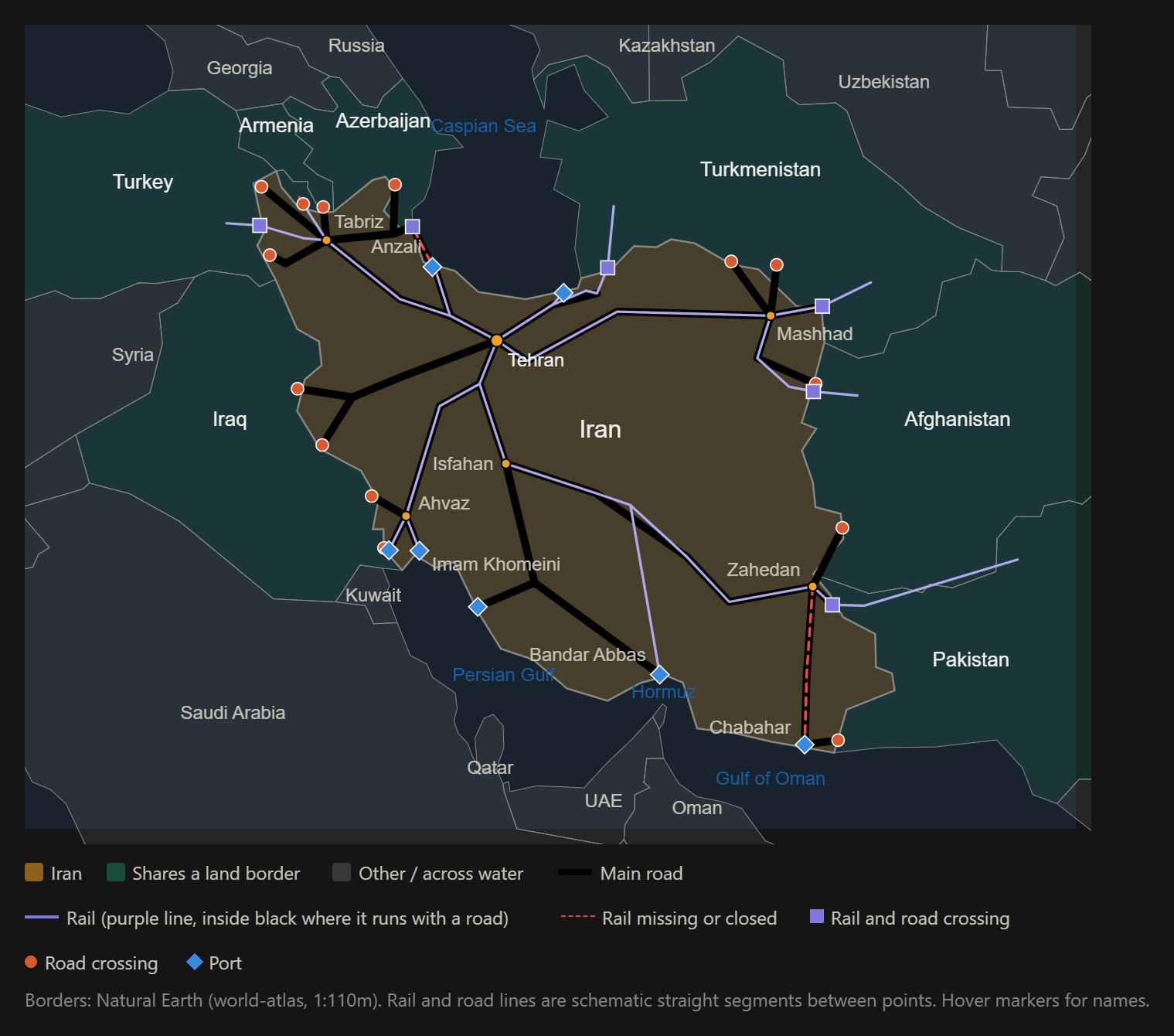
With no end in sight to the war, Iran’s best non-Hormuz options to move their energy and freight is rail. These routes include rail links through Turkmenistan to Central Asia and China, and by road, through Turkey and Iraq.
Freight capacity on these alternative routes is far below the capacity of the southern ports they’d be replacing.
Treasury says Iran has turned to rail to keep its economy running under the blockade, including to move oil and sustain regional trade.
The timing of these sanctions coincides with a big Iranian rail project recently completed.
Iran finished laying the track and final infrastructure construction of the 730-kilometer Chabahar-Zahedan line on September 25, 2026. This line was the first direct, heavy rail connection to a deep water port (the Port of Chabahar) to bypass the Strait of Hormuz. The rails would connect the ort of Chabahar to the national and Eurasian rail neworks. Cargo would be able to be unloaded outside the Persian Gulf and transported inland by train.
Petrochemicals, fuel derivatives like ammonia, industrial machinery, autoparts, chemicals, agriculture and food security cargo, minerals, steel, coal, mineral ore and concentrates all move by rail.
Here's the list of the sanctioned companies and what Treasury has indicated what they do.
Iranian automakers
Iran Khodro (IKCO) and SAIPA together hold over 90% of Iran’s domestic car market. IKCO is the largest automaker and has close ties to the IRGC. SAIPA is second, and together they build nearly 1.5 million vehicles a year.
Iran Khodro Diesel is an IKCO subsidiary and Iran’s largest maker of buses, trucks, and diesel engines. In other words, it builds the road freight fleet.
Pars Khodro and Zamyad are SAIPA subsidiaries. Pars makes passenger cars and Zamyad makes commercial vehicles.
Niroo Motor Shiraz is Iran’s largest motorcycle maker. Treasury alleges it uses prison labor and supplied more than 6,000 motorcycles for plainclothes intelligence agents. Niroo Motor Damavand belongs to the same group.
Treasury calls autos Iran’s largest economic sector outside oil and gas, and says many “Iranian” cars are actually imported from third countries and rebranded.
Foreign auto parts suppliers
PT Golden Motorcycle International (Indonesia) shipped auto parts to Niroo Motor Damavand.
Integrated Auto Parts LLC (Dubai) routed parts to Iran through the UAE, including parts transshipped from Turkey and India.
Troy Trading (Istanbul) sent truck parts to Bahman Diesel, which builds heavy trucks for Iran’s armed forces, including the IRGC’s drone and missile units.
Hessenberg Co. (a.k.a. Jedburgh Co.) and Tanex Global Trading (both Hong Kong) supplied parts to IKCO and SAIPA.
Rail
Islamic Republic of Iran Railway Company (RAI) is the state-owned railroad, running both passenger and freight service.
Raja Passenger Trains took over part of RAI’s passenger business and runs domestic and some international routes.
Sherkat-e Rah Ahan-e Haml-o-Naghl (Railway Transportation Company) is a private freight operator that Treasury calls key to sustaining notable railway activity.
Heavy equipment and metals
HEPCO (Arak) is one of the Middle East’s largest makers of mining and road-building machinery such as bulldozers and excavators. Treasury says the IRGC used its equipment to build underground facilities. HEPCO Shanghai is its Chinese subsidiary, which buys raw materials and parts for the Iranian plant.
Silver Line Metal Trading (Dubai) sells stainless steel to Iranian steelmakers.
Tech-Trade International Impex (Hilden, Germany) sold precursor materials to Mobarakeh Steel, the Middle East’s largest steel producer.
Traco International FZE (Ras Al Khaimah) received payments from Khouzestan Steel through Iranian exchange houses.
The Keshvardoust steel, oil, and shadow-banking network
Ramin Keshvardoust is a Hong Kong-based businessman with Iranian and Dominican nationality. Treasury says his companies facilitated tens of millions of dollars in Iranian steel and oil shipments and laundered money for Iran’s shadow banking system.
Shanghai Ruimi, M and R Steel (Beijing), and Fidar Foolad Radman (Tehran) are his steel trading companies.
KGT Trading, Dominion Trading Group, Bonasol Group, Meizi Co., and East Concord Development (all Hong Kong) are shells. Since early 2025, they received dozens of transfers worth tens of millions of euros and dollars on behalf of a Bank Shahr-linked company. Bonasol and East Concord share the same address (Rm 2610, Apec Plaza, Kwun Tong), and most of these shells were incorporated in 2023–2024, both typical shell-company signs.
This is the latest economic weapon the United States has unleashed on Iran. Sanctions don't need to block every shipment to be effective. Transport and industrial supply chains are key to a country’s economy. These sanctions will further constrict Iran’s earnings power.