


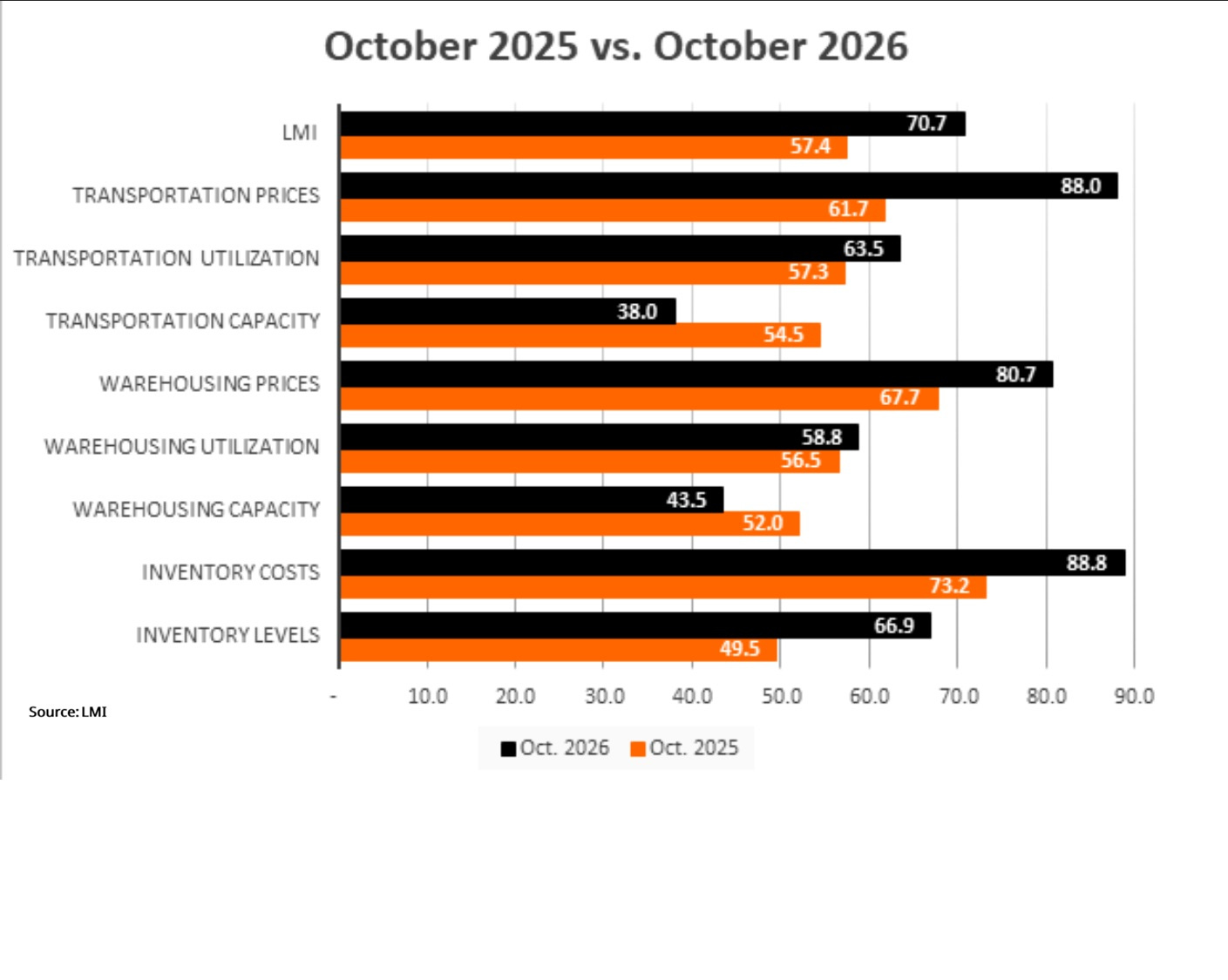
Inventory costs hit 88.8 in October, the highest since March 2022, as companies frontload goods ahead of tariffs.
Aggregate logistics costs reached 257.5, the fastest expansion since March 2022, according to the Logistics Managers’ Index.
Spot warehouse demand is moving inland to manufacturing and rail-served hubs in the Midwest and South-Central U.S.
Flexe expects spot and lease warehouse rates to rise in Q4 2026.
Warehouse space is priced at a premium for U.S. companies. The latest warehousing data show the influence Trump tariffs have had on nearshoring, onshoring, and overall tariff-mitigation strategies.
The October Logistics Managers’ Index (LMI), which tracks inventory levels, warehouse costs, transportation capacity, and pricing, rose to 70.7, up slightly from 70.2 in September and the second-highest reading in four years.
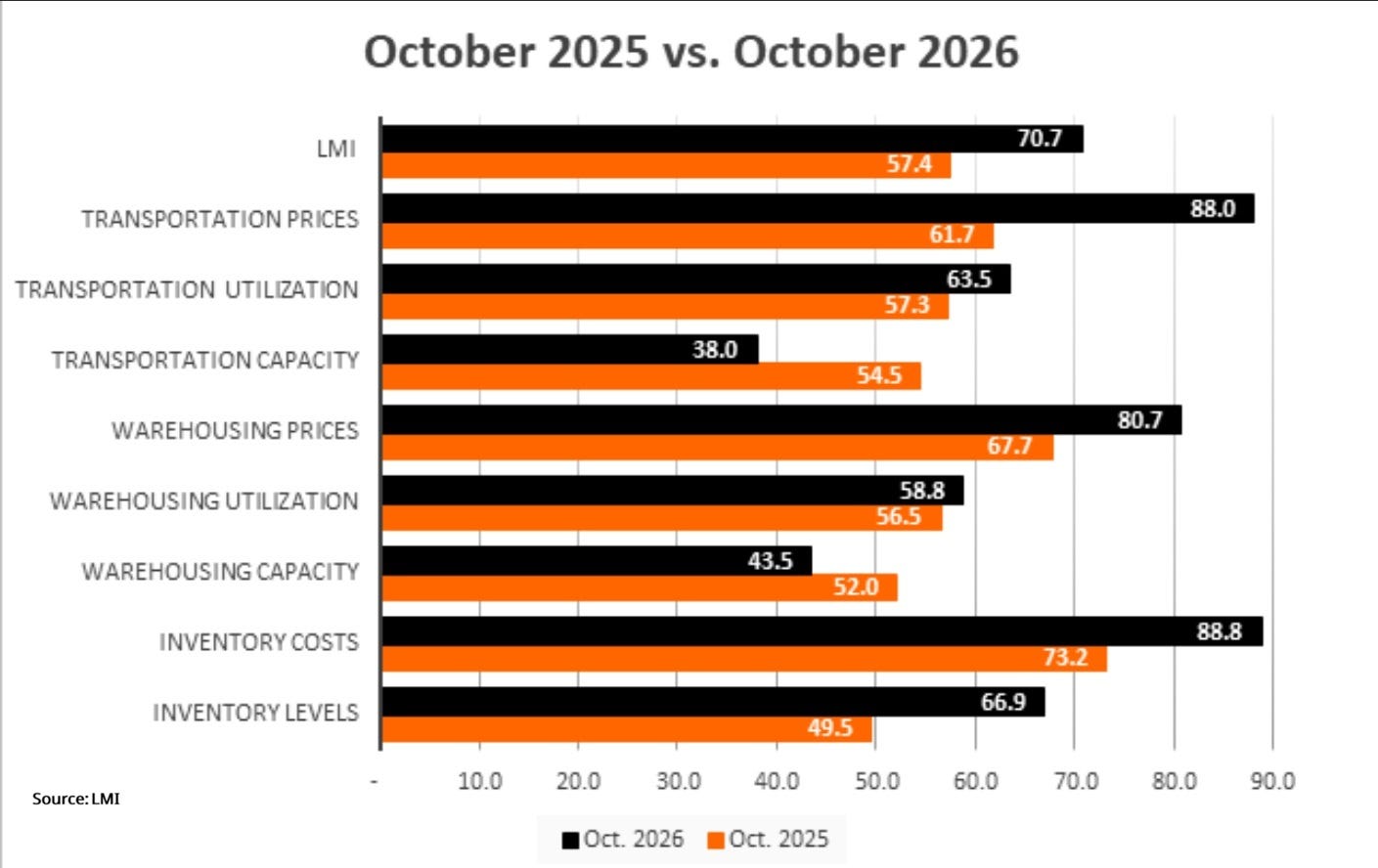
Dale Rogers, a professor in the supply chain management department at Arizona State University and one of the authors of the LMI, explained the primary driver behind the October results is a sharp expansion in Inventory Levels.
“Retailers are building stock faster than the upstream suppliers,” said Rogers.
Upstream suppliers are the vendors that provide the components, raw materials, or services required to build a product.
“This is a clear sign of holiday season preparation,” said Rogers. “That inventory buildup is coming at a cost: Inventory Costs surged to 88.8, the highest reading since March 2022.”
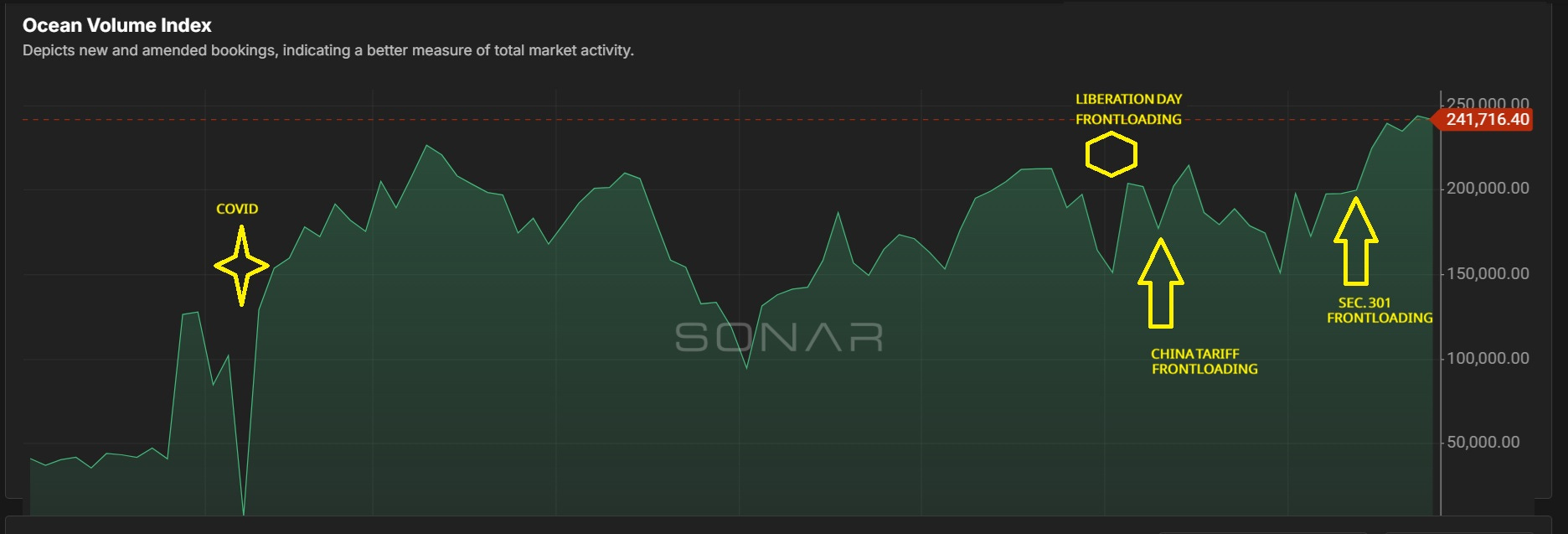
The reason behind the inventory build is companies pulling product forward ahead of the U.S. Trade Representative’s 301 Forced Labor tariffs, which went into effect July 23.
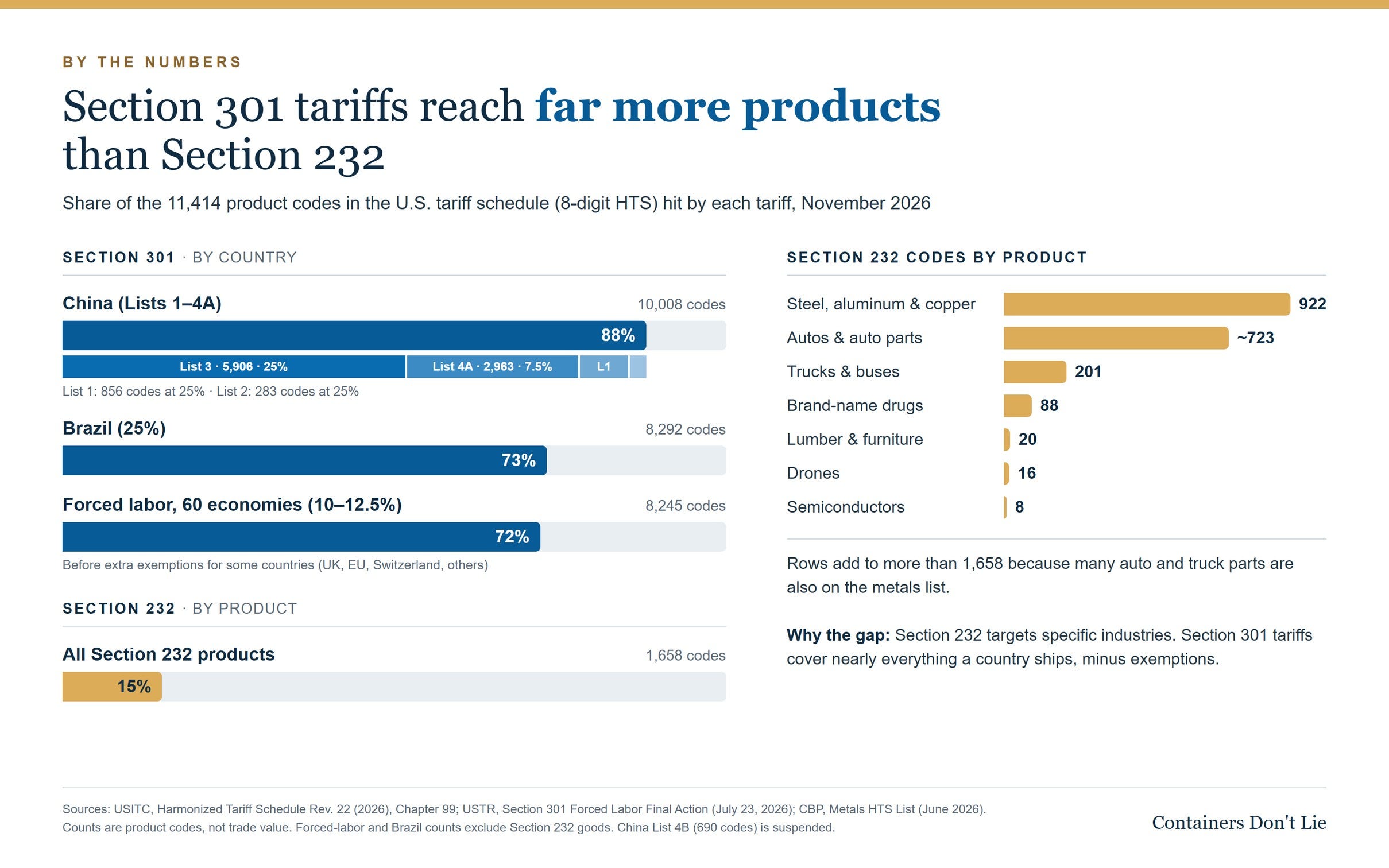
Tariffs are layered, so depending on the completed product and its components, companies can pay multiple tariffs. A standard athletic shoe can face a total tariff bill between 32.5% and 50%, according to the Footwear Distributors and Retailers of America.
Some companies are also paying additional duties and tariffs, such as Section 232 on Steel and Aluminum.
That is why companies bring in freight ahead of a new tariff date to avoid higher costs.
Tariffs and Strategy
Tariffs are used as a negotiation tool in the world of politics. While they may be bargaining chips for governments and might not happen, companies need to move forward with their plans regardless of whether the tariffs take effect.
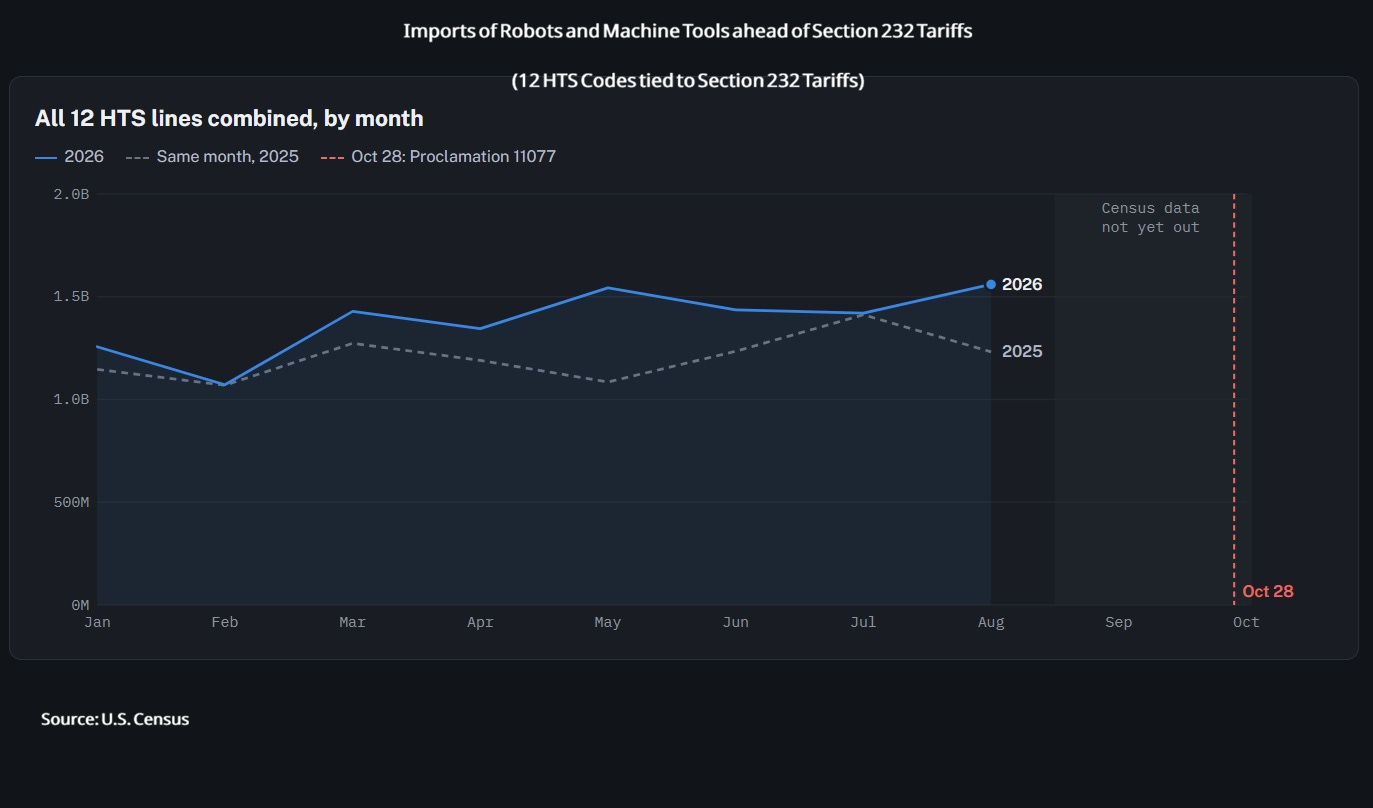
Last week, President Trump declined to impose Section 232 tariffs on imports of robotics, industrial machinery, and their parts and components. The Department of Commerce (DOC) and the office of the United States Trade Representative (USTR) were directed to continue negotiating an agreement with trading partners.
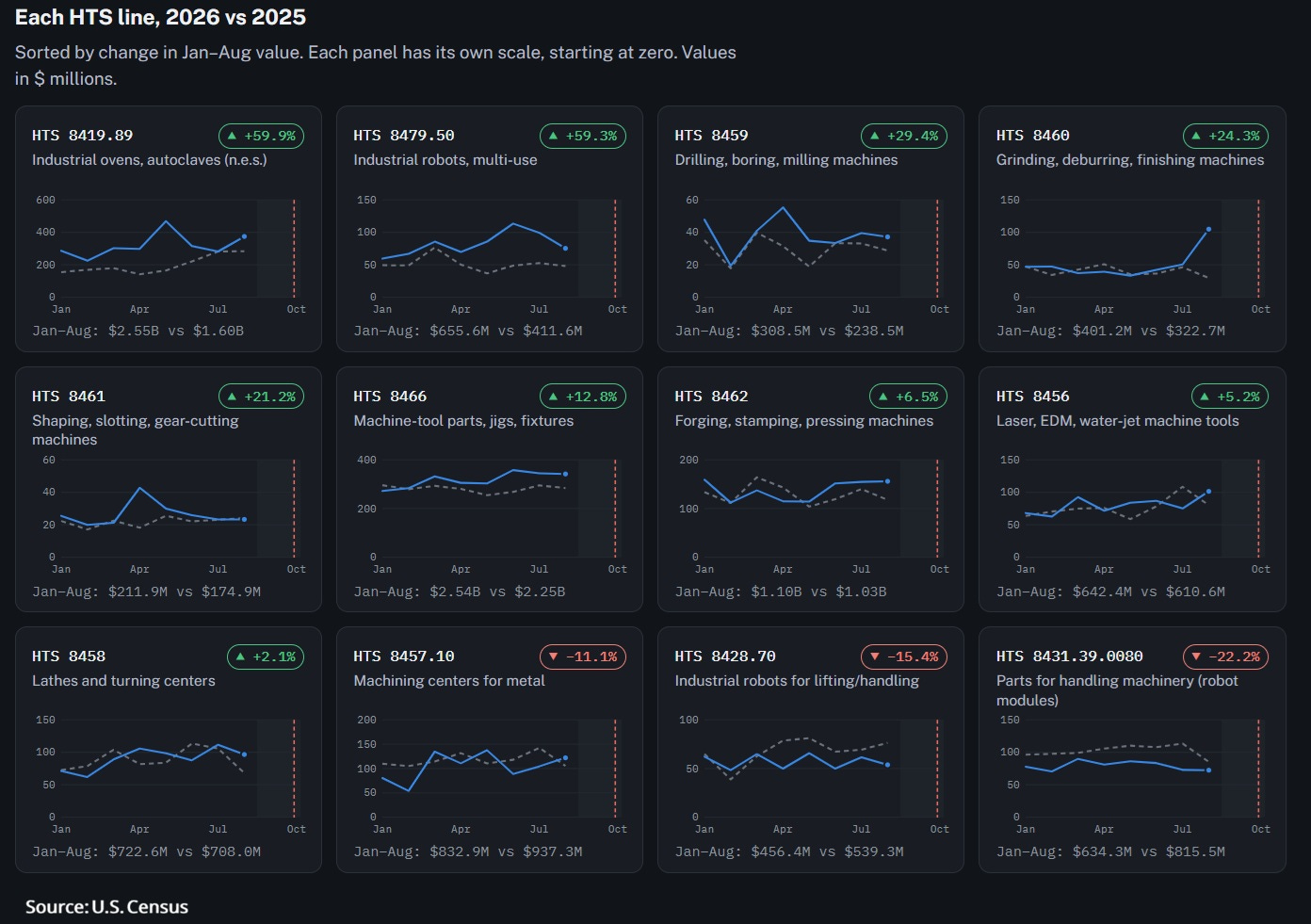
This tariff would have covered 12 Harmonized Tariff Schedule codes. U.S. Census data shows the frontloading.
Here’s the product code snapshot. You will notice some items have decreased.
All of the frontloaded products for the holidays and manufacturing are now sitting in warehouses and adding to inventories. Section 301 tariffs on Forced Labor have been the biggest driver of freight coming in early this year.
These higher inventories continue to keep both Warehousing Capacity (43.5) and Transportation Capacity (38.0) tight and prices up.
Warehousing Prices jumped to 80.7 in October.
More freight means you need additional trucks to move these products.
This comes at a time when the world has a refinery capacity issue due to the U.S./Israel war with Iran and the Russia/Ukraine war. Diesel is a distillate fuel that needs to be refined, which is why diesel prices continue to rise. Decreased diesel availability is driving the increase in LMI Transportation Prices.
Warehousing and trucking are the second-largest logistics costs for a company. Typically, warehousing accounts for 20% to 30% of total supply chain spend.
Collectively, trucking, warehousing, and associated costs and fees represent the total expense of delivering a product to its destination. It is often referred to as “landed costs.” These costs are on top of raw material costs, manufacturing, and ocean or air freight logistics bills.
Companies factor landed costs into a product’s price. According to MIT’s Center for Transportation & Logistics, freight and logistics costs represent 12–18% of product cost for most consumer packaged goods.
“Combined, Aggregate Logistics Costs in October hit 257.5,” said Rogers. “This is the fastest rate of expansion since March 2022. A signal that supply-side pressures could feed through to broader inflation in the months ahead.”
Flexe Spot Warehouse Index
Another warehouse index showing the influence tariffs and wars have had on the supply chain is Flexe’s Spot Warehousing Index. Flexe is the largest marketplace for flexible, on-demand warehousing in North America.
I like this index because it shows where companies are positioning their freight in the short term.
Traditional warehouse contracts can run up to five years. In today’s logistics supply chain moves, companies need that optionality, and spot warehousing gives them the ability to be nimble.
“One vertical that sticks out in terms of an increase in demand is in inland markets for industrial manufacturers and industrial products,” said Karl Siebrecht, founder and CEO of Flexe. “We can’t see whether these were arriving via Intermodal or not, but demand for capacity from this vertical has increased.”
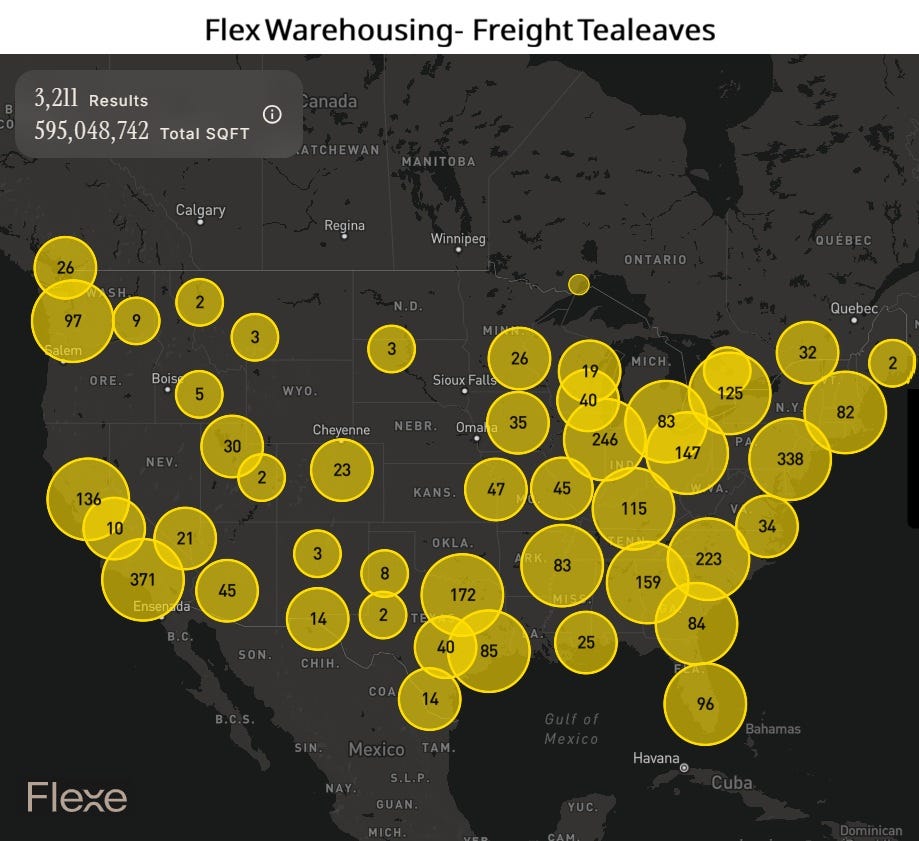
Siebrecht explained spot warehouse demand is moving toward inland manufacturing and rail-served hubs in the Midwest and South-Central US, toward Canada, and toward newer, automation-ready buildings.
The Spot Warehousing Index rose from $13.77 per pallet in July to $14.16 in August, then fell to $14.14 in September. Flexe expects both spot and lease rates to rise in Q4 2026.
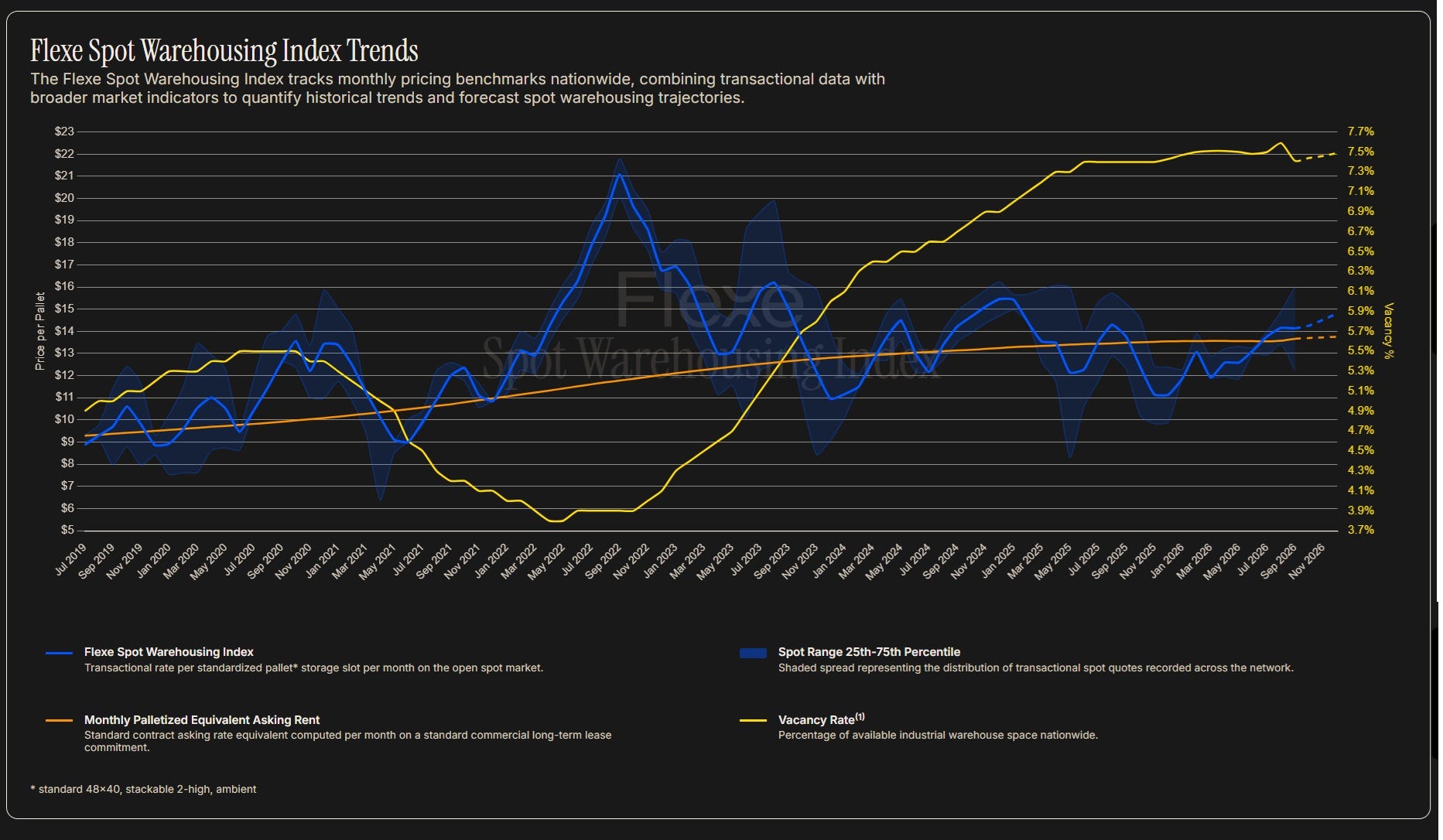
Flexe data shows port markets and the overbuilt Sun Belt markets that were created to meet COVID demand are cooling off. Retailers and wholesalers are trying to find space closer to their distribution centers and manufacturing plants.
Like the LMI, spot warehousing is also heavily influenced by reshoring, energy prices, and the data center boom.
According to Flexe market trend data, manufacturers took more than 12% of US warehouse leasing in the first half of 2026, up from 7.6% in 2022. Factory activity is at a four-year high.
Infrastructure spending for data centers and construction has increased over the last couple of years, and this year has been no different as demand for computing power has grown.
Data center vacancy is at or near 1% nationwide, according to CBRE, JLL, and Avison Young. That is the tightest of any commercial real estate category.
We have also seen a shift toward moving imports inland to warehouses and factories by rail to avoid rising truck costs. As a result, intermodal rail volume is on a record pace.
Another factor driving spot warehousing: newer builds.
Flexe calls the move of tenants seeking these newer spaces “a flight to quality.” In 2025, buildings with modern, automation-ready space filled up faster while older stock lost tenants.
Warehouse spot rates fell 22% from Q3 to Q4 2025 and bottomed in December, when the new series of tariffs was announced. Frontloading followed, and you saw a correlation between the rise in spot warehouse pricing in Spring 2026.
Many supply-chain signals offer clues to why retailers and manufacturers make the decisions they do. Those decisions then trickle down into every node of trade.
Warehousing, the intermediary between manufacturing and the consumer, shows how early companies bring in freight to avoid tariffs. Where they place their product offers keen insight into their delivery strategy.