


Rail investment is a key component in the Port of Long Beach’s $3.3 billion “Port of the Future”
Containers moved by train are credited with Port of Long Beach fluidity
Our biggest enemy is time, and we’ve got to look for ways to deliver this infrastructure and come up with process improvements that optimize operations,” Port of Long Beach CEO
The world of trade is immense. Consisting of approximately 3,700 major ports and terminals and 2,817 airports. The waterway superhighway moves the bulk of the items we consume, wear, and use.
Ports need to be efficient to move this trade. As cargo and energy volumes grow, ports must operate and process container surges driven by geopolitics. This is where port efficiency depends on the back end: the labor to move the product, and trucks and rail to transport containers to their final destination.
The Ports of Long Beach and Los Angeles form America’s largest container gateway. Together they move around 31 percent of the U.S. containerized international trade and support 2.4 million jobs nationwide.
China is the number 1 trading partner for these ports.
The U.S./China trade war and the global trade war have influenced the tremendous number of containers arriving at those ports.
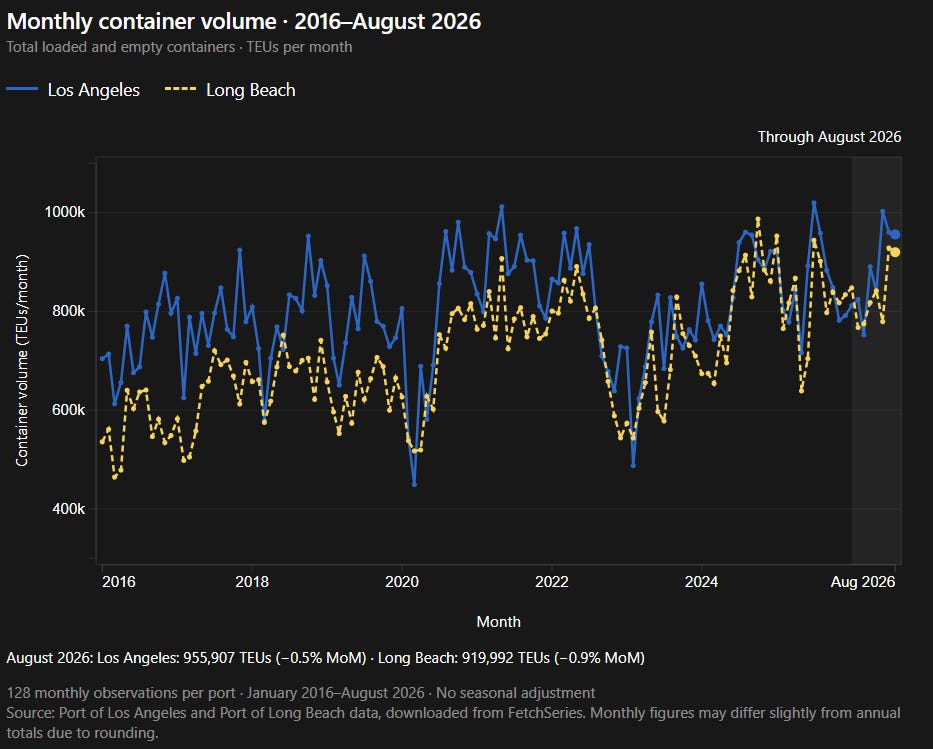
This is why trade must move smoothly through the ports, so congestion doesn’t delay vessels and products can reach their final destinations.
The ports of Long Beach and LA, along with other U.S. ports, are moving container volumes not seen since COVID. Both Long Beach and LA have praised the precision of the terminals, labor, trucks, and rails in moving containers at a steady cadence and avoiding the vessel backups we saw during the pandemic.
The surge of containers is a result of U.S. companies trying to navigate tariff, geopolitical, and environmental uncertainty.
2026 has been marred by a series of trade actions: the Supreme Court Ruling declaring the International Emergency Economic Powers Act illegal, the Section 122 tariffs, and now the 301 Forced Labor Tariffs. All of these tariff actions created a surge of containers coming into the United States.
But the year is not over, and so are the chances for yet another container surge.
The 301 tariff on structural excess industrial capacity and manufacturing overproduction is expected to be announced in the coming weeks. The Panama Canal is facing drought conditions in what is being characterized as a “Godzilla El Niño”, and next deadline for U.S./China negotiations is January 10.
“I think the deadline will also generate another round of front-loading activity,” said Hacegaba.
The prior tariff actions created an earlier peak season for the ports of Long Beach and Los Angeles.
This continued volatile trade environment has the Port of Long Beach pressing on the accelerator on its $3.3 billion “Port of the Future” project.
The project would create the world’s first fully zero-emissions seaport and double the port’s annual cargo capacity to 20 million TEUS (twenty-foot equivalent units or containers). The “Port of the Future” concept dates back to at least 2015. The broader environmental foundation dates back to 2005.
“We have to be nimble enough to pivot and demonstrate that we can handle the container surges,” said Hacegabaa.
Why rail is the centerpiece of Long Beach’s “Port of the Future”
The Port of Long Beach rail strategy is designed to move containers off the docks faster, expand on-dock capacity, and keep cargo flowing into the national freight network.
This “Port of the Future” project has several water and land components.
The first is the $318.5 million Deep Draft Project, which would deepen the main entry channel and container basin to 80 feet to accommodate the newest generation of large neo-Panamax vessels at any time. Right now, at low tide, the vessels cannot make it into the port.
“The Port of Long Beach is the only port on the West Coast that can handle these ultra-large crude carriers, and this project, by deepening our channel, will enable us to move more energy products that the United States desperately needs to keep its transportation system going forward,” said Hacegaba. “What the project will also do for us is it will enable container ships to access our inner channel.”
The port’s four outer harbor terminals are its largest by capacity and have no draft constraints. But the two terminals in the port’s inner channel need expansion. The Deep Draft project will redevelop and expand capacity at the four larger terminals and increase container capabilities and capacity at the two inner channel terminals.
The next project is considered the linchpin of the Port of Long Beach’s performance accelerator.
The Pier B On-Dock Rail Support Facility ($1.8 billion), which would triple the port’s on-dock rail capacity to 4.7 million TEUs annually and slash container transfer times out of the port from 4 days to 24 hours. The project will expand the 82-acre rail yard to 171 acres.
Hacegaba stressed that the need to expand the rails is greater than ever because of the number of containers the port receives each month.
Also fueling rail use is the higher price of diesel.
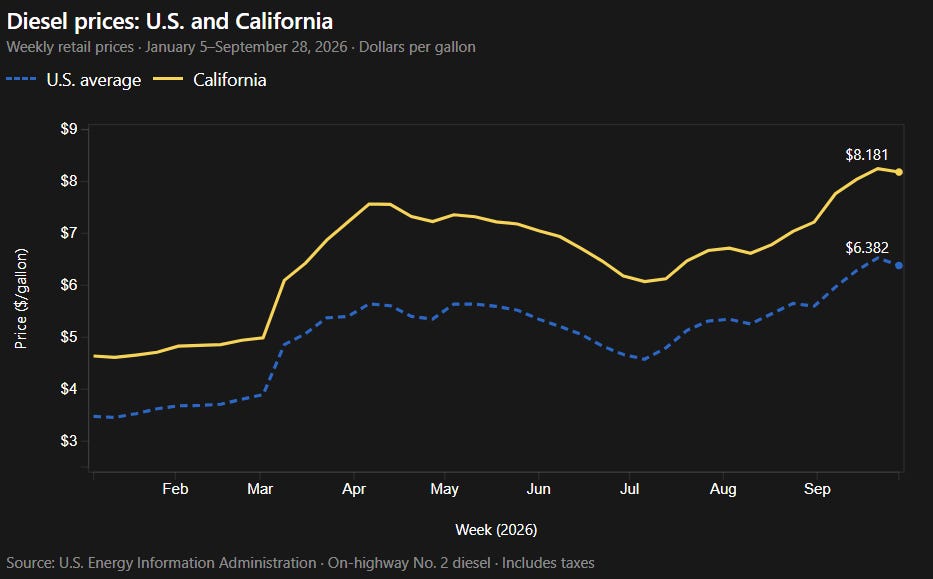
More shippers are moving freight off the roads to the rails to avoid higher diesel prices.
This has triggered what’s called the “intermodal squeeze,” which means containers need to wait longer to leave the port by train. Wait times have risen during peak season, averaging 6.34 days. This is the highest backlog for trainbound containers since early this year.
“This motor shift from local truck delivery and on-dock rail is giving us that capacity that we desperately need to keep that cargo moving and make sure the product reaches its final destination,” said Hacegaba. “In the long term, it's key to our future. This plan is the largest of any port in North America, and the centerpiece of that investment plan is one project. That's our 1.8 billion-dollar Pier B On-Dock rail support facility.”
Hacegaba says it would triple their on-dock capabilities and connect the port to the nation's 30 major rail hubs.
“It will enable us to double our cargo volumes to 20 billion TEU by 2050,” he continued. “This is why I say that speed to market is a key to our success. Rail connectivity is a key to our future. So we are all for more rail moves because it's more efficient, it's more reliable, it's more predictable, and it's more sustainable.”
The Port of Long Beach currently has 102,000 containers across its six container terminals. They have not seen this inventory level since July of 2022. Hacegaba credits the modal shift with moving the containers so swiftly without congestion.
This is why the Port of Long Beach expansion is closely tied to increasing rail capacity: moving more containers efficiently is essential as trade volumes and supply-chain pressures continue to change.
The third piece of this port upgrade is the proposed Metro Express Terminal at Pier S. It would be the world’s first conventional, zero-emissions terminal. Once final environmental approvals and commercial agreements are signed, developers project construction will take roughly 3 to 5 years. Environmental impact approvals and lease agreements are expected to be fully approved and signed by early/mid 2027.
Impact of Higher Energy Prices
The cost of construction has greatly increased in 2026 not only due to tariffs but also because of the U.S./Israel’s war on Iran and rising energy prices.
It’s a one-two punch for construction budgets: tariffs make manufactured steel, aluminum, lumber, parts, and components more expensive, and the trucks moving those products to the site and removing dirt from the site run on expensive diesel.
Just like regular construction, marine construction and modern infrastructure development are exposed to energy prices. Shifting fuel and utility rates are a major variable in a project’s price.
The Deep Draft Navigation Project could face “Dredging Inflation”. The high fuel costs (marine gas oil and diesel used by tugs and transport barges) will increase the expense of displacing 7 million cubic yards of sediment. You also need to remove the silt dredged and transported miles away.
The dredges will also need additional electricity to operate. California’s electricity is around $0.34 per kWh, which is nearly double the U.S. Average.
Looking at overall California power generation, the latest energy data shows solar generation is increasing and outpacing natural gas.
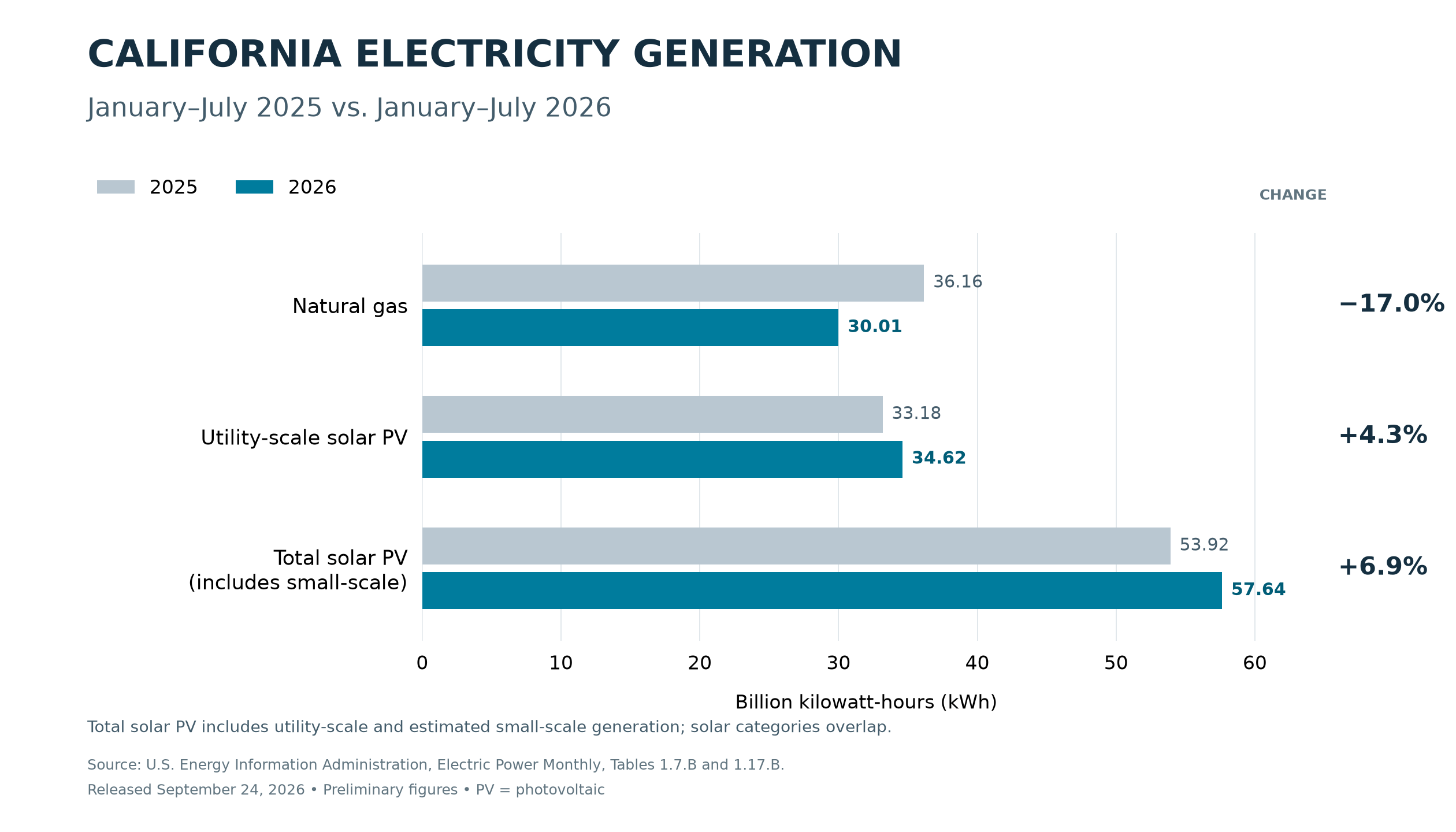
To manage the risk of energy price fluctuations, the U.S. Army Corps of Engineers regularly updates its Cost Engineering Dredge Estimating Program (CEDEP). Energy-driven inflation has already pushed the project’s total projected cost baseline from an initial $170 million to $318.5 million. Hacegaba said the port does not expect to adjust the project budget because of higher energy and tariff costs, citing record funding and efforts to deliver the infrastructure as quickly as possible.
“Our biggest enemy is time,” said Hacegaba. “We’ve got to look for ways to deliver this infrastructure and come up with process improvements that optimize operations here on the ground, so that the transaction between ship, truck, and trade is more efficient.”
For the Port of Long Beach, that focus on speed, rail connectivity, and efficiency is ultimately about one thing: keeping cargo moving from ship to market.