


In January–September 2026, 88% of U.S. consumer-goods imports ($446 billion of $506 billion) came from the 16 economies in USTR’s Section 301 investigation into structural excess manufacturing capacity, according to an analysis of U.S. Census Bureau data.
USTR’s Section 301 investigation targets 16 economies that supply 77% of all U.S. imports, including key U.S. allies.
Exposure is concentrated in tech and electronics (Apple, Nvidia, AMD), consumer retailers (Walmart, Amazon, Costco, Target), autos (GM, Ford, Tesla), and pharma (Eli Lilly, Pfizer).
Look around your room or peruse your stock portfolio, and chances are the products or stocks you own could be smacked with another set of tariffs.
The United States Trade Representative is expected to announce its findings on its Section 301 investigation into structural excess manufacturing capacity. That means a government-subsidized factory with unused capacity. Sixteen economies, including major U.S. trading partners in the Indo-Pacific and Europe, as well as Mexico, are being targeted.
This investigation is going on at the same time the U.S. government is negotiating trade agreements with about twenty economies.
In October, five of the 16 economies targeted in this Section 301 probe (EU, India, Japan, Mexico, and South Korea) signed a Joint Ministerial Statement to address global excess capacity and production in key manufacturing sectors.
At this point, with all the tariff news, consumers and investors are numb, and it’s become background noise. I wanted to drill down on the trade data to provide some context.
Using U.S. Census data, the excess-capacity tariff could reach three-quarters of everything the U.S. imports and nearly 9 out of every 10 dollars of imported consumer goods.
Remember, this latest Section 301 is just one tariff. All tariffs are layered on top of each other. They add up and get passed on to the consumer. I explained all of that in my latest analysis looking at the tariff and Iran War impact on transitory inflation.
Dave Townsend, a partner in Dorsey & Whitney’s International Trade Group, explained that once the findings are announced, he will be looking for differences in tariff rates among the different countries.
“The labor Section 301 tariffs set a mostly uniform 10-12.5% rate for U.S. imports,” said Townsend. “Presumably, the excess capacity Section 301 duties will differentiate among different sources of U.S. imports, based on how the Trump Administration views those trading partners.”
Which Countries Targeted
On March 11, 2026, the USTR opened Section 301 investigations into “structural excess capacity” in 16 economies: China, the EU, Mexico, Vietnam, Japan, South Korea, Taiwan, Thailand, India, Switzerland, Malaysia, Singapore, Indonesia, Cambodia, Bangladesh and Norway.
Countries targeted responded forcefully.
Vietnam’s letter to USTR stressed, “structural excess capacity does not exist.”
In a letter to USTR, Singapore’s Ministry of Trade and Industry wrote that its exports to the U.S. are not due to excess capacity and, in fact, “The US has enjoyed a consistent trade surplus with Singapore for over 20 years.”
Norway’s ministry of foreign affairs wrote that the country plays a strategically valuable role for the United States by ensuring reliable and stable oil and gas production aligned with global demand.
In its letter to USTR, India's Ministry of Commerce and Industry "firmly denies all allegations made in the initiation notice" and asked USTR to terminate the investigation. India also argued that because the two countries are negotiating a Bilateral Trade Agreement, any trade concerns should be handled in those talks, not through unilateral measures, according to PTI.
You may remember President Trump announced he had a trade deal with India back on February 2, 2026.
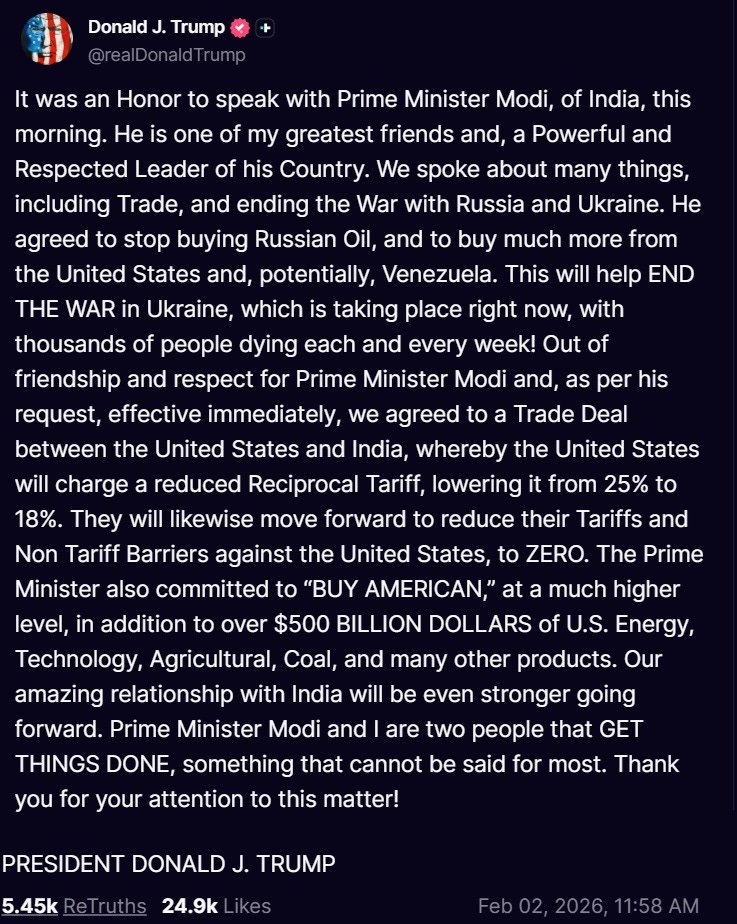
But nine months after Trump’s February 2 post, India has delivered almost none of what Trump said India agreed to. Partly because the deal itself still isn’t signed.
In a letter regarding this Section 301, India’s commerce and industry ministry wrote, “Since India and the United States have initiated a process of negotiating a Bilateral Trade Agreement, any trade concerns should be addressed within the framework of the trade negotiations and not through unilateral measures.”
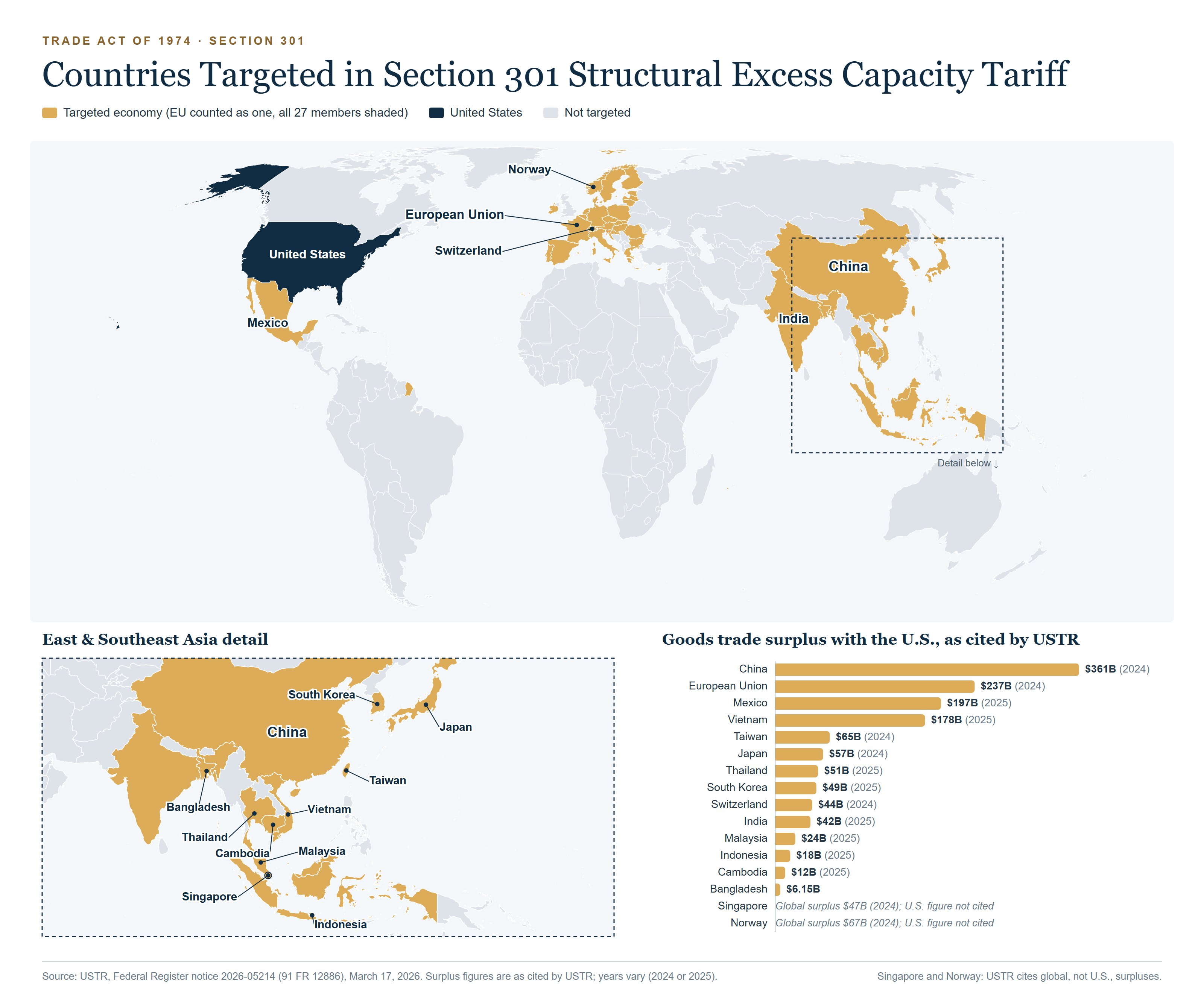
This 301 directly attacks the countries involved in the “China plus one” sourcing strategy. Once a safe haven from tariffs, now in the crosshairs.
The tariff threat has already had some companies crunching the numbers to evaluate whether it makes sense to continue manufacturing more in Vietnam.
Dollar-wise, when evaluating the layering of these tariffs, some are considering moving more manufacturing back to China and away from Vietnam. The reason: the tariff payments would be almost the same, and China’s manufacturing and speed are superior to Vietnam.
Mexico, another country benefiting from China’s expansion, is also one of the top countries on the tariff list. The United States-Mexico-Canada Agreement USMCA trade treaty would not shield Mexico from this tariff.
China still dominates manufacturing in some products: cookware (58%), toys (45%), and phones (30%). The European Union dominates pharma imports at 87%. Around 71% of cotton apparel is targeted. It would have been higher, but Central America (Honduras, Guatemala) is not on the list.
Tariff Layering
As I have explained before, tariffs add up and are layered. This latest tariff would include the same 16 countries as the separate Section 301 on Forced Labor (tariffs range between 10–12.5%).
The USTR’s case for this tariff leans on surplus numbers. China’s global goods surplus was $1.2 trillion in 2025. Mexico’s surplus with the US was $197B and Vietnam’s $178B.
The Section 301 identifies 21 sectors “plagued by excess capacity”: steel, aluminum, autos, batteries, semiconductors, solar modules, ships, chemicals, machinery, robotics, satellites, processed food, and more.
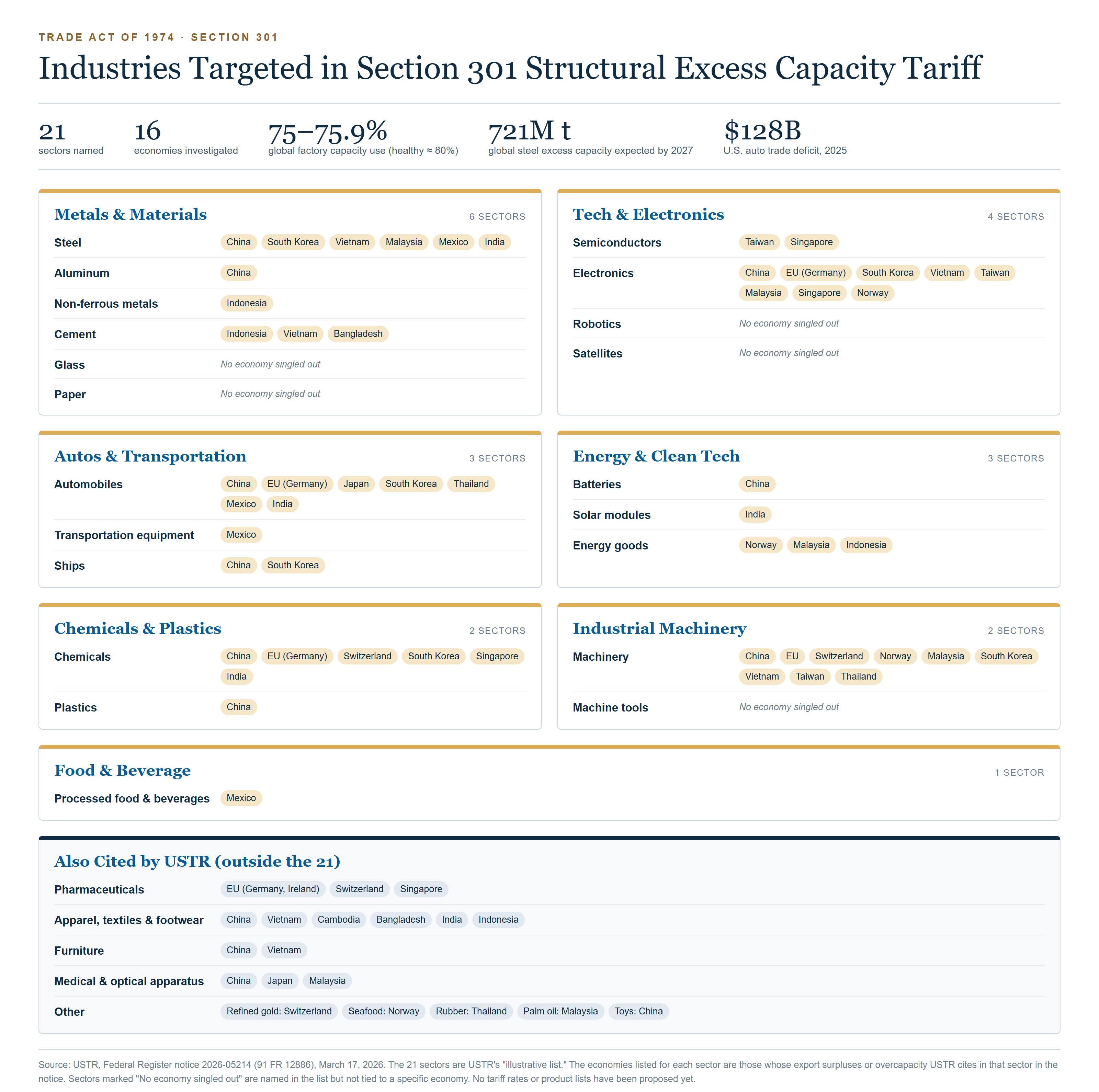
This 301 investigation by USTR expanded beyond the list of 21 industries. USTR also flagged pharma (Ireland and Switzerland), apparel and footwear (Vietnam, Cambodia and Bangladesh), and even Norwegian seafood and Swiss gold.
What this means for Consumers
“Nearly 9 in 10 Dollars” of U.S. consumer goods imports could be smacked with tariffs. 88% of US consumer-goods imports in Jan–Sep 2026 came from the 16 targeted economies: $446B of $506B.
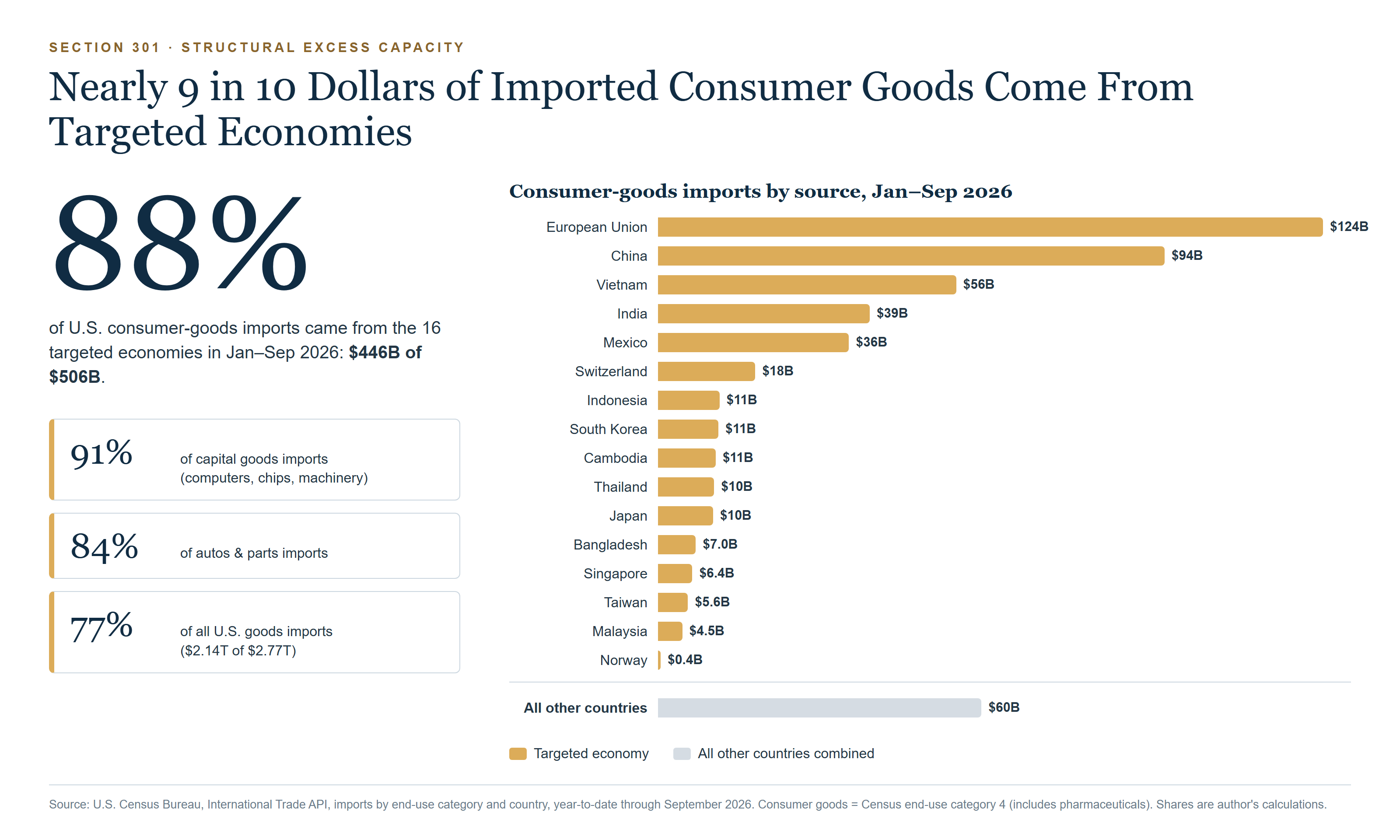
The tariff target is even higher for the things that run the economy: 91% of capital goods (computers, chips, machinery), 84% of autos and parts, and 77% of all US goods imports ($2.14T of $2.77T).
U.S. allies will feel the brunt of this tariff; the biggest consumer-goods sources are the EU $124B, China $94B, Vietnam $56B, India ($ 39 B), and Mexico ($ 36 B). Every other country in the world combined supplied just $60B.
The U.S. consumer’s shopping cart is almost entirely exposed. According to the U.S. Census, the shares of 2026 U.S. imports from targeted economies are: TVs (98%), footwear (96%), appliances, toys, and cookware (95%), cell phones (94%), pharmaceuticals (92%), and furniture (91%).
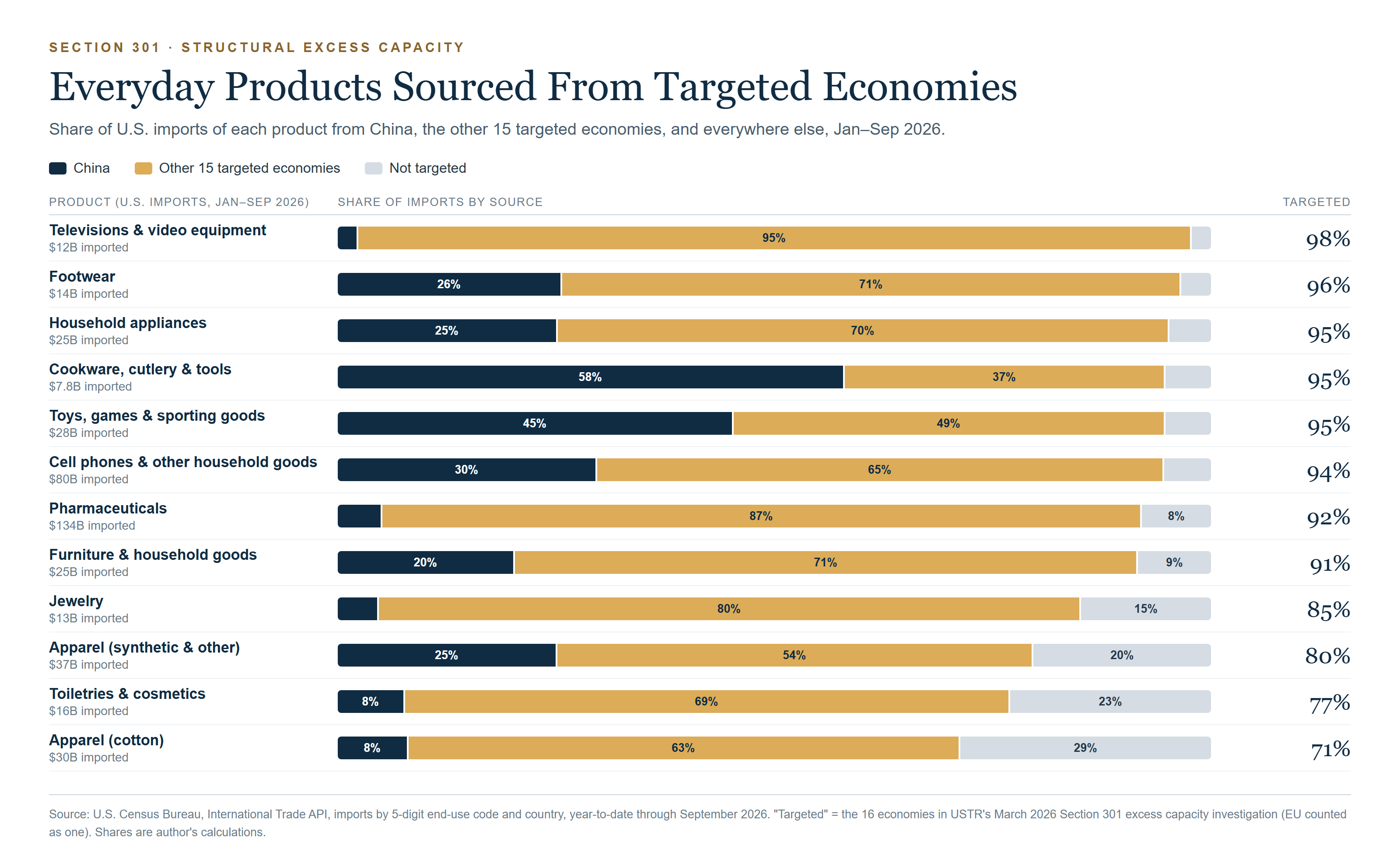
The share of US imports from the 16 targeted economies rose from 76% to 77% in 2026, according to the U.S. Census Bureau.
Thailand is up 69%, Taiwan +60%, Malaysia +48%, Vietnam +46%, South Korea +35%, Cambodia +24%, and Mexico +21%. China, the EU, and Switzerland declined by 11%, 15%, and 59%, respectively.
AI servers and chips from Taiwan, Mexico, and Southeast Asia drove the surge in capital-goods imports (43%). Pharma imports fell 44% ($237B to $134B). Taiwan U.S. imports are now tied with China, at about $215B each this year.
Wall Street Wallop
Investors also need to know which sectors are most impacted.
Based on an analysis of S&P 500 companies by industry, 153 of the 503 S&P 500 companies, or 30%, are in industries USTR targeted or that rely on imports from the 16 economies.
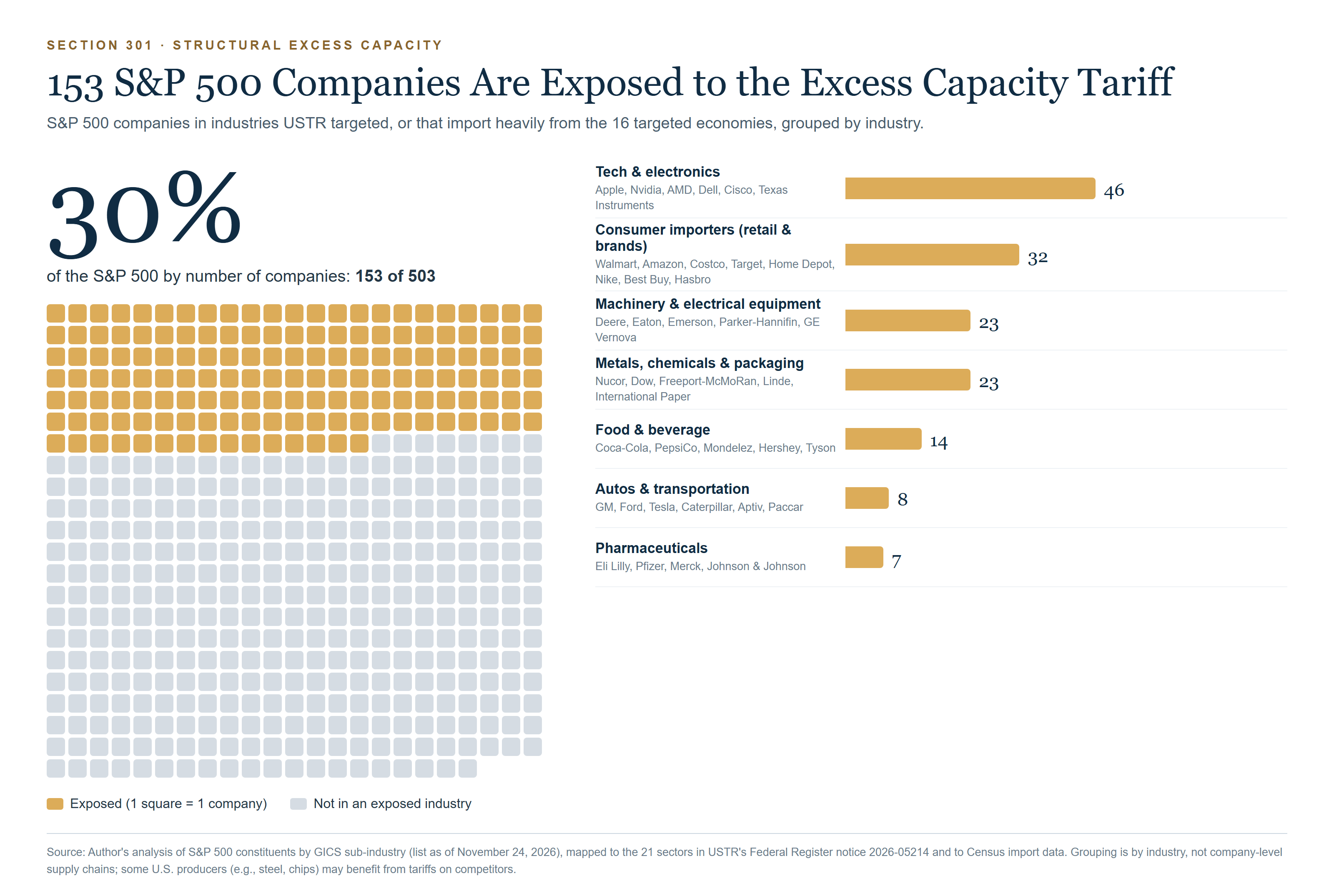
Here’s a running list of companies. You’ll see Nvidia, the stock everyone is talking about now, could be exposed to this tariff.
Tech and electronics: 46 (Apple, Nvidia, AMD, Dell, Cisco)
Consumer importers: 32 (Walmart, Amazon, Costco, Target, Home Depot, Nike, Best Buy, Hasbro)
Machinery: 23 (Deere, Eaton, GE Vernova)
Metals and chemicals: 23 (Nucor, Dow, Freeport)
Food and beverage: 14 (Coca-Cola, PepsiCo, Hershey)
Autos: 8 (GM, Ford, Tesla, Caterpillar)
Pharma: 7 (Lilly, Pfizer, Merck, J&J)
Also exposed: about 286 Chinese companies listed on US exchanges, worth about $1.1T (USCC), plus foreign shares like TSMC and Toyota that trade in the US.
But remember, not every company is a tariff loser. U.S. steelmakers (Nucor, Steel Dynamics) and U.S. chipmakers could benefit from tariffs on foreign competitors.
The global supply chain has evolved due to geopolitics. Just like the Liberation Day tariffs, these latest tariffs mean companies now have nowhere to hide.
This supply chain commentary is for informational purposes only and is not meant to constitute a recommendation of any particular investment, security, portfolio of securities, transaction or investment strategy. The views expressed in this commentary should not be taken as advice to buy, sell or hold any security. No data provided should be used to determine which securities to buy or sell. Consult your advisor about what is best for you.