


The U.S. supply chain is interwoven with countries around the world. Airfreight is needed to transport key components essential to the completion of many U.S. products, and thus a major driver of the U.S. economy.
Air freight is used for transporting high-value, time-sensitive, or specialized components. The belly space on planes accounts for approximately 33% of the total value of manufactured goods transported. Don’t discount the less than 1% of total volume (by weight) of world trade.
Unfortunately, the countries the U.S. relies on for components needed to complete manufacturing projects cannot compete with Asia’s deep pockets in the energy area.
Asia continues to outpace Europe in buying up stock.
An analyst from Kpler said, “Diversions explicitly away from Europe were at least four vessels (around 300kt) and occurred at the start of the war, specifically early March. Most jet fuel will stay in Asia for the time being, given the pricing.”
And Asia shows no signs of letting up.
The volatility in Asian fuel oil and bunker futures has sparked another day of action from Platts.
For a second day in a row, Platts, part of S&P Global Commodity Insights, announced incrementality measures in select Asian fuel bids to manage volatility.
“Due to high volatility in refined products futures markets, the maximum incrementability has been amended for eWindow…” the alert said.
Platts continued with its maximum incrementability measures on Platts HSFO/MF0.5% Physical and Platts HSFO/MF0.5% Derivatives (outrights only), and Platts Bunkers Physical.
“Platts’ widening increments signal a market under extreme stress, to be honest,” said Jelle Vreeman, independent shipbroker.
Energy traders say Asia is outbidding Europe at $8- $10 a barrel. In some cases, even more.
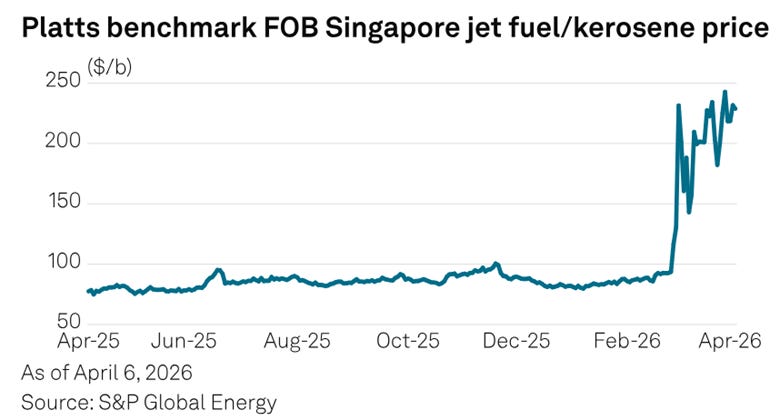
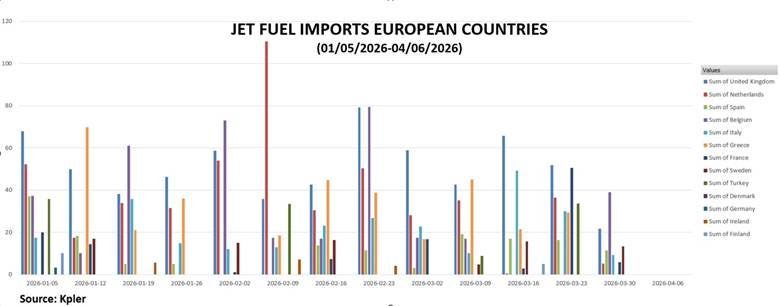
This outmaneuvering by Asia has decimated Europe’s jet fuel imports.
So why should U.S. investors care?
Europe is a major U.S. air freight exporter to the US. grappling with lower jet fuel inventories.
U.S. companies are facing a triple whammy of higher air freight costs, diminished belly capacity, and the risk of not receiving critical equipment on time.
Airborne components manufactured in Europe are critical to the U.S. economy.
Pharmaceuticals, aerospace parts, automotive parts, electronics, high-end fashion, advanced machinery, specialized AI/cryptocurrency hardware, and specialized data center and artificial intelligence equipment all move by air.
Major airports in Italy have announced fuel restrictions, and airlines in Europe are warning of flight cancellations. All have a direct impact on air freight capacity.
The fuel restrictions at Milan Linate, Bologna, Venice, and Treviso airports should be on investors’ radar. It’s not just your luxury goods that leave this country on the belly of a plane.
Aerospace components (specifically aircraft and helicopter components, up 23.7% to over $1 billion in 2025), pharmaceuticals, and “Made in Italy” perishables (such as cheeses) all leave via air freight.
Aircraft and helicopter components represent over 60% of Italian aerospace exports to the US. This vital sector is growing. Exports rose by 8% to top U.S. hubs like Virginia and Texas, aided by zero-tariff agreements on aviation parts.
