

Supply-chain planning has become increasingly short-term and difficult to predict.
Frequent tariff and policy changes prompt companies to make quick decisions
“More companies are now saying tariffs are going to be a permanent feature,” said Willy Shih, professor of management practice in Business Administration at Harvard Business School.
Frequent supply chain disruptions and bottlenecks have tested companies’ resilience, but their pivots have affected global trade flows.
I was recently asked on the Supply Chain Unchained Podcast about the strategies companies are using in today’s challenging supply chain landscape due to tariffs and wars. I said it’s no longer just-in-time. It’s about getting the product in.
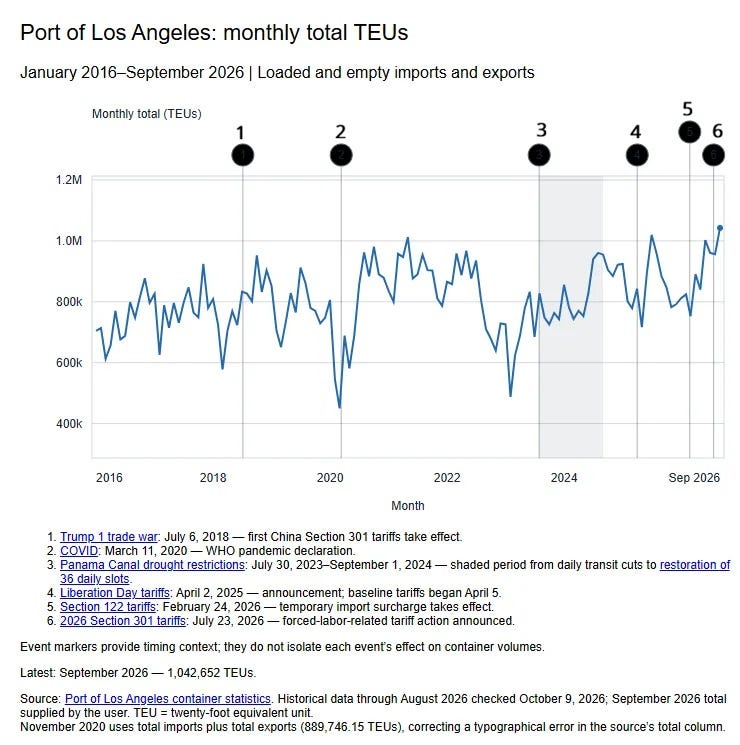
This frontloading is also one of the drivers fueling record volumes at the Port of Los Angeles.
Gene Seroka, executive director for the Port of Los Angeles, and Willy Shih, professor of management practice in Business Administration at Harvard Business School, discussed this practice at length at the port’s October media press briefing.
Supply Chain Optionality
Companies, large and small, are seeking optionality in their supply chains.
“I see more companies moving from purely optimizing for cost to optimizing for options,” said Shih. "The questions they are asking themselves are, ‘How do I create more optionality so I can move around?’ or ‘How do I hedge for tariffs?”
Front-loading has been a lower-cost option for companies right now than relocating and rebuilding supply chains elsewhere. Why? Because tariffs keep changing, companies don’t have a clear picture of where to invest. Building supply chains in other countries takes time.
Many products, from cheap T-shirts and fast-fashion clothing to electronics and footwear, are too costly to make in America and don’t make sense to produce here. For products that can be reshored, building that manufacturing base won’t happen overnight.
“Diversification of supply chains is happening, but it’s going a lot slower than people would like,” said Shih.
“The big change I see is that more companies are now saying tariffs are going to be a permanent feature,” said Shih. “It used to be this way back in the 1960s through the 1980s. Tariffs were higher, and trade flows weren’t as strong as they are today.”
Shih said companies are changing their sourcing strategies based on where suppliers can deliver.
“So we’re seeing a lot of contract renegotiation, though that’s a different game than reshoring,” said Shih.
Both Seroka and Shih warned that this short-term trade strategy has created surges in container volumes, but the numbers could be misleading. The high container count may not reflect strong consumer demand. It’s more likely a combination of challenges facing shippers: tariffs, Panama Canal restrictions, and tight raw-material supply.
This is why you need to know the why behind the numbers.
Cargo surges may reflect inventory timing, disruptions, or attempts to get ahead of policy changes rather than a lasting shift in demand. This goes back to the discussion about data vs. intelligence. You need the intelligence to decipher the data and understand why it is happening.
Knowing the reasons lets you create scenarios and a solid game plan.
Asian Export Demand Expected to Continue
The movement of a container offers clear insight into the future of trade. You need the box to transport goods.
A telltale sign of strong demand for Asian goods is the high volume of empty containers that returned to the Port of Los Angeles in September. These containers are expected to come back loaded with more product. The Port of Long Beach and the Port of Seattle/Tacoma have also seen an increase in empty containers heading back to Asia. The Port of Oakland has seen a decrease.
For the near term, Seroka said purchase orders in Asia remained solid, but November and December are harder to forecast.
“While China’s share of our business at the port has dropped from 60 to 40%, we’ve continued to grow, as that sourcing starts to really take effect in Southeast Asia,” said Seroka. “When I’m in Hong Kong, Guangzhou, and Shanghai over the next 10 days, the one thing I’ll be checking is: what do these purchase orders look like? Is there a rate of cancellation, or are orders steady 90 to 120 days out?”
The manufacturing buildout in Southeast Asia has been a major driver of U.S. imports.
Vietnam exports to the U.S. have quadrupled over the last 10 years. This intra-Asia trade has been lucrative for ocean carriers.
Supply Chain Planning
Before the first trade war and pandemic, there was a cyclicality to maritime trade.
“It used to be you could do planning on an annual basis,” said Shih. “Now, with all these tactical things, it’s making it really hard. So, until our leaders get together and get some stability, we’re just going to have to be in an environment where people are planning contingencies and creating options.”
Supply chain experts say companies can plan for optionality by using AI across their entire product value chain. A value chain is the full cycle of a product: from creation to delivery. This includes sourcing materials, manufacturing, assembly, and transporting the product to customers.
The us of AI supports company employees in their decision-making across suppliers, procurement, production, inventory, logistics, and sales. All parts of the value chain depend on one another to complete a product and deliver it to market.
By using AI at each origin point of the supply chain, companies can prepare multiple scenarios. If a supply chain node is delayed, the effects snowball throughout the value chain. By understanding each node intimately, a company can plan for delays and pivot.
For example, a company might adjust a planned promotion so customers aren’t encouraged to buy products that won’t arrive on time. No company wants a sale if it doesn’t have the inventory to fulfill it.
“AI will memorize all the decisions that have been made, their context, their optionality, their expected outcome, and then puts that in a memory,” explained Fred Laluyaux, CEO of decision intelligence AI company, Aera Technology. “That memory doesn't lie. You can plan with optionality by using AI to keep track of choices considered and what happened after the decision. It’s more than identifying the risk. You manifest the decisions that need to be made with the help of humans in real time.”
Laluyaux said ongoing tariff disruptions and wars are prompting companies to rethink their supplier networks.
“This has forced organizations to rethink what their supplier network is, and to build a couple of options and backups,” said Laluyaux. “And that’s creating a lot of complexity as well.”
In practice, this kind of decision memory can help teams compare alternatives, learn which ones worked, and respond more consistently when similar supply-chain risks arise.