
U.S. rail traffic growing 3.2% YOY
El Niño mitigation measures have the Panama Canal Authority reducing vessel transits in September
Ocean Carrier, ACL is offering North America landbridge alternatives for shippers
Port delays in 2022 led Hapag Lloyd, Norfolk Southern, Union Pacific, and Port of Virginia to come up with a new trade model for East Coast to West Coast shipping.
Maritime weather is cyclical, and each event teaches logistics lessons. Seasonal events may be more severe or milder than the previous one, but solutions used in prior weather events can provide clues as to how trade will flow and who will benefit. Based on history, intermodal will be a winner from the upcoming El Niño event due to Panama Canal diversions.
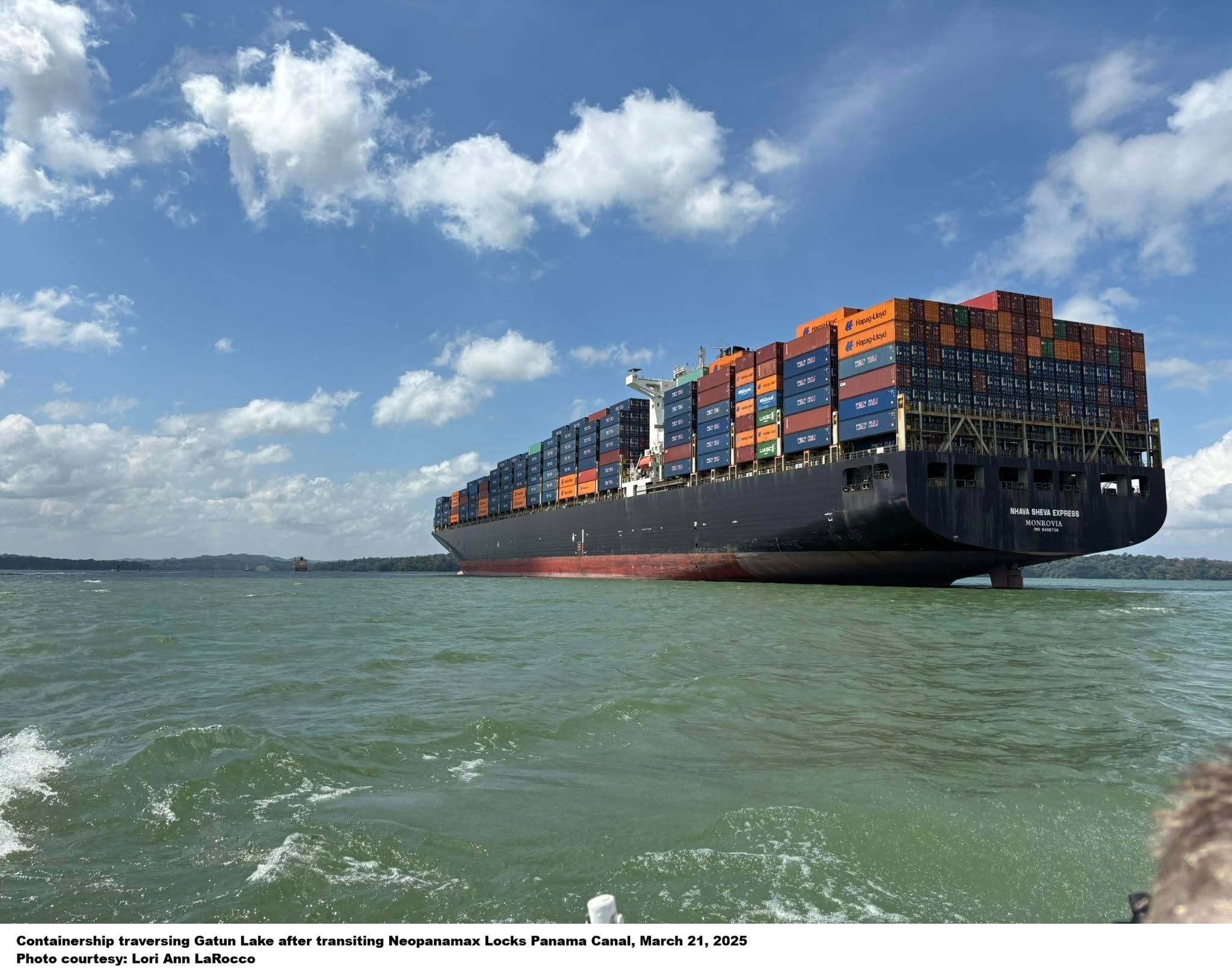
The man-made Panama Canal relies on rainfall to operate. During the last El Niño, the Panama Canal Authority (ACP) reported a 29% drop in vessel transits during fiscal year 2024. The biggest hits were in LNG and dry bulk transits. LNG transits were down 66 percent, while dry bulk transits were down 107 percent.
After the historic El Niño of 2023, the ACP created a daily transit auction system in 2024 and recently amended it to a Long-Term Slot Allocation System (LoTSA). The ACP also created a dedicated booking system for Liquefied Natural Gas (LNG) vessels. Other options included the auction mechanism and last-minute reservations.
Three auction slots are reserved daily to accommodate segments like LPG and LNG that need space on short notice. Auction slots are up for the highest bidder to secure transit. Canceled bookings can be added to the auction slots. This can increase the daily availability by 3-5 slots.
Demand for these slots has been so high that winning bids continue to hit historic price tags. An auction slot hit $4.6m was purchased by South Korean liquefied petroleum gas (LPG) supertanker G. Arete, owned by SK Shipping Co.
Before the war, auction slots ranged from $135,000 to $140,000. Bidders for a slot ranged from two to three. Now the highest bidder count for one slot was 18. These bidding prices are expected to go even higher due to Mother Nature.
Weather experts are warning this upcoming El Niño will be a “Godzilla” or “Super El Niño.” The Met Office warns this El Niño will be the “strongest in living memory.” Given that this weather phenomenon will be worse than the last El Niño in 2023/24, the Panama Canal Authority is taking proactive measures now to conserve water.
This is why intermodal will benefit.
Vessel transits will be reduced in September, with daily transits dropping from 36 to 32 over the month. Vessel draft (which affects a vessel’s carrying capacity) has been lowered in a series of announcements. More draft announcements cannot be ruled out.
These mitigation measures mean more cargo must be diverted off the ship and onto a land bridge across Panama, or diverted altogether and moved via rail across North America.
In an exclusive gCaptain interview, Ricaurte Vasquez, administrator of the Panama Canal, explained to me that the severity of El Niño led to the earlier announcement of a reduction in vessel transits. He also said this weather phenomenon will be longer.
“The strategy here is somewhat different from what we had because the conditions were different,” said Vasquez. “The soil is drier now, so there is less water retention currently in the surrounding areas and the watershed, which makes things more complicated. The start of the dry season in the Panama Canal is probably going to start earlier than December now, in November. It’s going to last longer. Rain is going to start probably at the end of April, maybe in May. So we have to look at a very long time in terms of hydrology. Looking forward, we are making sure every drop counts.”
This means the trade restrictions and subsequent diversions will be longer. Simply put: more containers moved by truck or rail = more profits.
The United States is the largest user of the Panama Canal, accounting for about 73% of Panama Canal traffic and 40% of all U.S. container traffic traveling through the Panama Canal each year. Approximately $270 billion in cargo is handled annually.
European trade uses the Panama Canal to reach the West Coast of South America. Year to date, a total of 20.3 million tons (5.2%) has been moved. Trade from Europe to the West Coast of North America also uses the Panama Canal. This trade route represents roughly 10.5 million tons (2.7%) of year-to-date traffic. These vessels carry manufactured goods, technology (data center parts and structures), and components.
This El Niño is coming at a challenging time for the Panama Canal. Traffic through the canal has increased due to the Iran War and Houthis Red Sea rerouting. Energy transits have substantially increased as more U.S. energy flows through the Panama Canal to Asia.
Additional canal surcharges have led some carriers to announce cuts to vessel services through the Canal. ONE clients have shown me the advisory announcing the cutting of three vessel strings through the canal. ACP Administrator Ricaurte Vasquez told me they met with the ocean carrier last week to discuss the changes.
“They understand the situation,” said Vasquez. “They have to redeploy. They have to deliver cargo on time, and they have to do whatever they need to do. We have rules and regulations that apply to everyone, and then we sit with them and say, okay, how about if you do A, B, and C? You can bring a larger vessel. You can do transferring at this place. The slots are available, so you look at what you want to schedule. Being transparent (on options) is critical to us.”
Historically, rail and truck have been used during the last El Niño to move trade through the Panama Canal bottleneck.
In 2024, Maersk initiated its rail landbridge service, where containerships unloaded containers at the Port of Balboa and transported them by rail across the country to reload them on vessels at the Port of Cristobal.
Expect more transshipments like this once the vessel transits are reduced in September. Trucking across Panama will also increase. DHL, C.H. Robinson, and Kuehne+Nagel are just some of the companies moving freight along the landbridge.
The intermodal boom will also be seen in the United States. Shippers will use ports along both coasts as ways to bypass the canal, moving freight via rail or truck.
The CIIT (Corredor Interoceánico del Istmo de Tehuantepec), a land-based “dry canal” connecting the Atlantic and Pacific oceans, is expected to benefit as an alternative to the Panama Canal. The CIIT is at Mexico’s narrowest point, linking the Port of Coatzacoalcos (Veracruz) on the Gulf of Mexico/Atlantic with the Port of Salina Cruz (Oaxaca) on the Pacific. Final completion is expected by late 2026. Container volume on the CIIT is still low.
But on July 10, the corridor completed its largest automotive logistics milestone. The vessel Glovis Condor docked at Salina Cruz from South Korea, discharging 3,000 Hyundai and Kia vehicles. The autos were loaded onto specialized Trimax and Bmax railcars to make the 308 km interoceanic journey. The railcars traveled to Coatzacoalcos for final export to the United States.
U.S. freight is connected to CIIT in a variety of networks:
via the CG Railway rail-ferry service, which runs between the Port of Coatzacoalcos in Veracruz, Mexico, and Mobile, Alabama.
Mexican interchanges with Canadian Pacific Kansas City (CPKC) and indirectly with Union Pacific.
These North American rail options allow shippers to divert containers away from the Panama Canal. It can reduce cost and time. But it is important to stress the rail network capacity cannot replace the canal’s tremendous trade throughput.
Atlantic Container Line is offering a US West Coast Export Landbridge service via two routes. The first route runs from the West Coast to Europe, transporting the container by truck to Chicago. From there, CN Rail moves it from Chicago to Halifax, where it is loaded onto a vessel to Europe. The second route is Europe to the Port of New York/New Jersey. ACL transloads the cargo from an ACL container to a Matson Logistics container in New York, where it is moved by CSX rail to Chicago and then, depending on the destination on the West Coast, moved by Union Pacific (Oakland) or BNSF (LA & Seattle).
These containers will add to the surge of containers currently being transported by rail. This increase in rail freight is due to the Iran War’s impact on diesel prices diverting truck freight to rail.
U.S. rail traffic extended its growth streak to 20 consecutive weeks for the week ending August 22, 2026. A total of 532,462 combined units, according to the Association of American Railroads (AAR). This volume comprised 235,885 carloads, up 3.2% year over year, and 296,577 intermodal containers and trailers, up 5.0% from the same period in 2025.
CSX Transportation and Norfolk Southern, the two primary freight railroads operating across the Atlantic Coast and the eastern United States, both reported strong volume growth in their late-summer 2026 reports for the second quarter and year-to-date.
CSX achieved record-breaking second-quarter revenue, powered by a 9% year-over-year jump in intermodal traffic to 792,000 units as shippers pivoted heavily from highway trucking to more economical rail alternatives.
Norfolk Southern reported a 5% rise in intermodal volume alongside a 3% overall gain in coal carloads, driven significantly by a 25% surge in export coal moving through Atlantic Coast marine terminals.
Driven by a robust truck-to-rail modal shift, BNSF Railway saw an increase in its second-quarter volume by 7% year-over-year. The company saw a 9% increase in intermodal traffic, which lifted its total revenue 15% to $6.6 billion.
Union Pacific saw a 2% growth in overall carload and unit volume and a 12% boost in operating revenue to $6.864 billion. Double-digit gains in domestic intermodal, grain, and automotive sectors drove this growth.
Data from SONAR shows the total amount of containers (twenty-foot equivalent units) from the ports of Los Angeles, Long Beach, and New York/New Jersey. The containers moved over the water are standard 20-foot or 40-foot maritime containers.
Domestic intermodal freight moves domestic freight inside North America using large 53-foot private containers.
The increase in rail demand has also increased dwell times at West Coast ports.
“If a shipper has the flexibility of importing goods into the US West Coast instead of the US East Coast, then they must seriously consider it because there is dramatic savings potential, even if it means a heavier reliance on truck and rail to reach the final destination,” said Peter Sand, chief analyst at Xeneta. “This underlines the dynamic approach supply chain professionals must take in managing resilience and freight spend during major market shocks."
Brian Kobza, Chief Commercial Officer at IMC Logistics, said global supply chains are facing renewed pressure as West Coast ports experience significant congestion amid an unpredictable transportation landscape.
“Import rail containers are dwelling for more than two weeks at some terminals,” he said. “As a result, many shippers are shifting freight back to trucking and transload solutions to maintain velocity. Supply chain resilience and flexibility have become more critical than cost optimization alone.”
A historical data point showing how ocean diversions can increase rail profits was in 2022, when West Coast trade was diverted to East Coast ports to avoid ILWU labor disputes that slowed port operations.
In my series of CNBC reports, I wrote about Union Pacific/ Norfolk Southern’s cross-country rail endeavor. Hapag-Lloyd, Norfolk Southern, the Port of Virginia, and Union Pacific collaborated so West Coast-bound freight would be brought into the Port of Virginia and loaded onto Norfolk Southern railcars. The containers would then be loaded onto a UP railcar in Chicago bound for the West Coast. I said for months that this would boost rail profits for Union Pacific and Norfolk Southern. I was correct. Norfolk cited my reporting after its investor day.
If history can be any guide, this anticipated El Niño will fuel more intermodal growth. The tealeaves of trade are already pointing to the shift.


