

Christmas Trees and toys with Wi-Fi or Bluetooth are still facing Trump Tariffs.
U.S./Israel war with Iran has impacted the availability of petrochemicals.
Tariffs and petrochemical prices have raised the cost of artificial Christmas trees, but companies like National Tree are using IEEPA tariff refunds to stave off price increases.
American consumers are facing sticker shock this year with higher energy and food prices, so it’s only natural they want more bang for their buck this holiday shopping season. This includes not only the gifts they plan to buy but also holiday decor.
“We do a survey every year, and this year consumers are looking for value,” said Chris Butler, CEO of National Tree Company. “Consumers are looking for a deal.”
Butler saw this trend toward more affordable goods during Amazon Prime Days in October.
“Our Prime Big Deal (Christmas tree) sales were sub-$200, according to Butler. “We’re definitely continuing to see that shift toward the lower end of the market.”
“We’ve seen signs with some customers that things are looking okay,” said Butler. “Our own site is doing very, very well. So there’s definitely momentum out there, but consumers are feeling it right now, and we’ll have more supply this year.”
Analysis of National Tree’s own website on Oct. 21 lists 478 artificial trees, priced from $24 to about $2,838. 449 of the 478 (94%) are on sale.
Artificial Christmas trees and decor are considered discretionary purchases.
The National Tree Company sells artificial Christmas trees and decor on its website, Amazon, Wayfair, and national retailers such as Macy’s, Home Depot, Lowes, and Walmart.
Holiday Spending
While some consumers start holiday shopping early, many hold off on most purchases until later in the season, with sales and promotions still playing an important role.
In a recent National Retail Federation’s annual consumer survey, nearly two-thirds (64%) of consumers say they are likely to wait until Thanksgiving weekend to do most of their shopping, up slightly from 63% last year.
NRF also reported that more than half of holiday shoppers (56%) said the state of the economy will affect their holiday spending plans this year. Customers now use the word “affordability” to describe their discretionary spending.
Among those consumers surveyed, 43% plan to shop for sales more often, 31% will comparison shop online more often, and 29% will use coupons more often, among other strategies to make the season more affordable.
“With affordability top of mind, holiday shoppers are taking a thoughtful approach to spending, balancing value with preserving traditions that make the holiday season special,” said Allison Zeller, NRF Vice President of Industry and Consumer Insights. “Retailers understand consumer budget priorities and are responding with compelling products, promotions and shopping experiences that make it easier to find value while still capturing the holiday excitement.”
Trump Tariffs on Christmas Trees
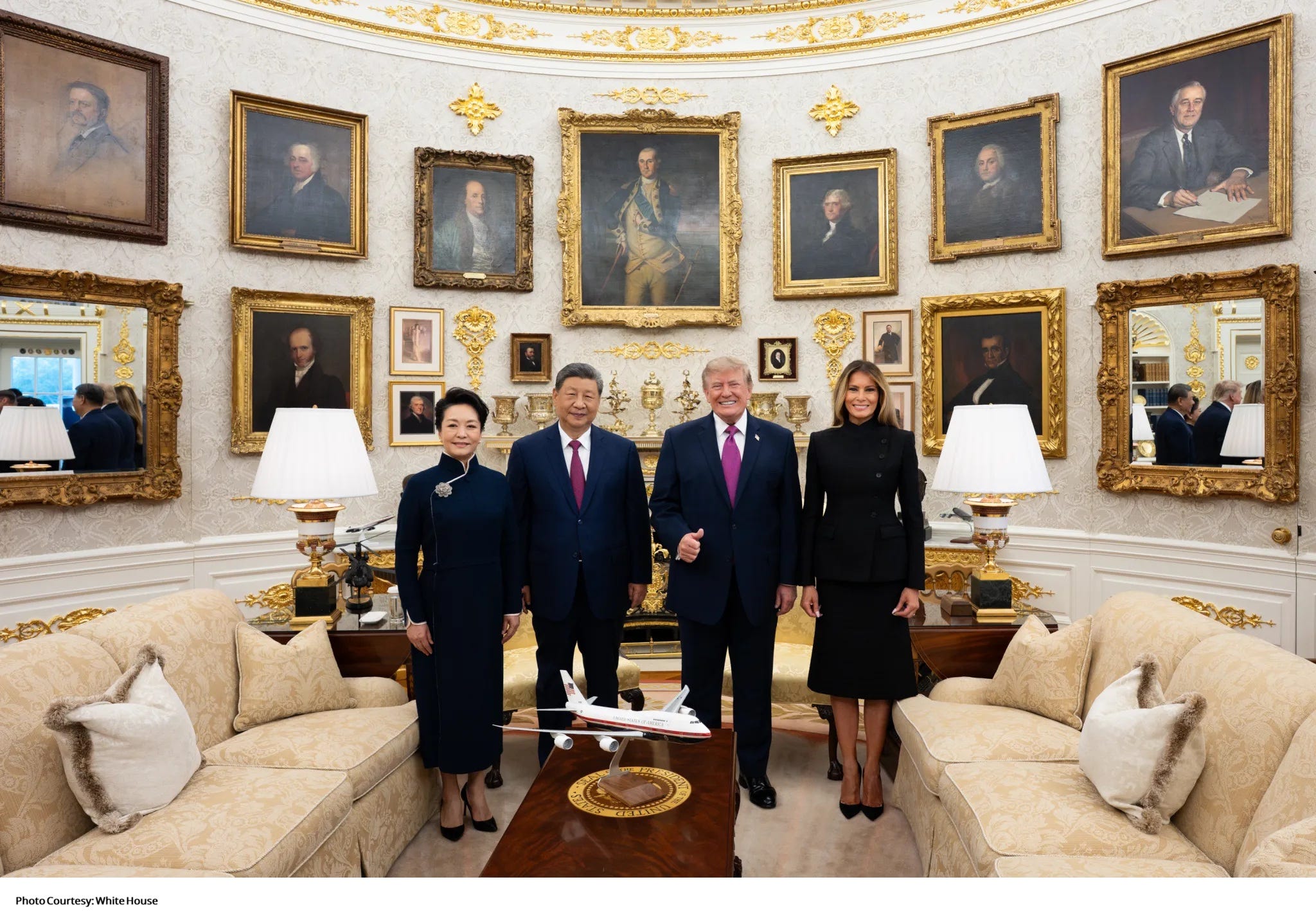
Christmas trees and Wi-Fi or Bluetooth toys are still being tariffed this holiday season. Artificial trees aren’t included in the “30-for-30” list of about $30 billion in “non-sensitive” goods that the United States and China pledged to cut tariffs on. This agreement was reached during the summit between U.S. President Donald Trump and Chinese President Xi Jinping.
Tariffs on artificial trees (HTS code 9505.10.50.10)
From China: 12.5%
From Vietnam: 12.5%
From Cambodia, India, and Indonesia: 10%
From Mexico and Canada: 10%, or 0% if they qualify under USMCA
Glass and wooden ornaments, nativity figures, and lamps are on the “30-for-30” list, but the tariff break hasn’t taken effect.
Why?
On Oct. 1, U.S. Trade Representative Jamieson Greer clarified in a meeting of the G20 trade ministers in Milwaukee that no date has been set because: “We have to stick to our legal processes.”
Historically, around 87% to 90% of artificial decor is made in China.
National Tree used to make products in the U.S. when it started in the 1950s. The company then moved manufacturing to Taiwan, and then ultimately to China.
A few years ago, the company made 100% of its goods in China. Today, with supply chain diversification, the company produces about 62% in China, with manufacturing in Cambodia and Vietnam. Butler credits its diversified supply chain with reducing its reliance on manufacturing in China.
“In the future, we’ll be anywhere from 75% to 50% out of China,” said Butler.
Moving manufacturing back to the United States, however, would be cost prohibitive.
“The costs would be astronomical,” he continued. “I may think it would be two to three times the cost of what we're doing today.”
National Tree Company bucks the industry manufacturing trend.
An estimated 90% of Christmas decor sold in the U.S. comes from China, according to the American Christmas Tree Association.
Tariff War Continues
The Liberation Day Tariffs in 2025 marked a supply-chain reckoning for all industries. National Tree Company imported 25% less due to tariffs.
Even though the Supreme Court’s International Emergency Economic Powers Act (IEEPA) ruling ordered the Trump Administration to refund companies seeking refunds, companies are still paying additional tariffs on their goods.
First, the temporary Section 122 tariffs were imposed immediately after the SCOTUS ruling. Then, after the Section 122 tariff expired in July, the Section 301 tariffs on forced labor began. The Section 301 tariff on forced labor has no expiration date. An impending Section 301 tariff on excessive manufacturing is also coming.
This is changing how companies are importing their products.
Retailers who would import the artificial trees directly would pay the tariffs themselves. Now they are moving to a Delivered Duty Paid (DDP) deal. In this model, the supplier handles shipping and customs, pays the duties, and delivers to the retailer’s door.
According to data compiled by ImportGenius, National Tree has imported up to 40% more than in 2025, year over year.
“Some of those imports we’re bringing in are specifically for some of our Direct Import (DI) partners. So with the tariffs, we are now the importer of record. This is why our numbers are up.”
Iran War Impact on Artificial Trees
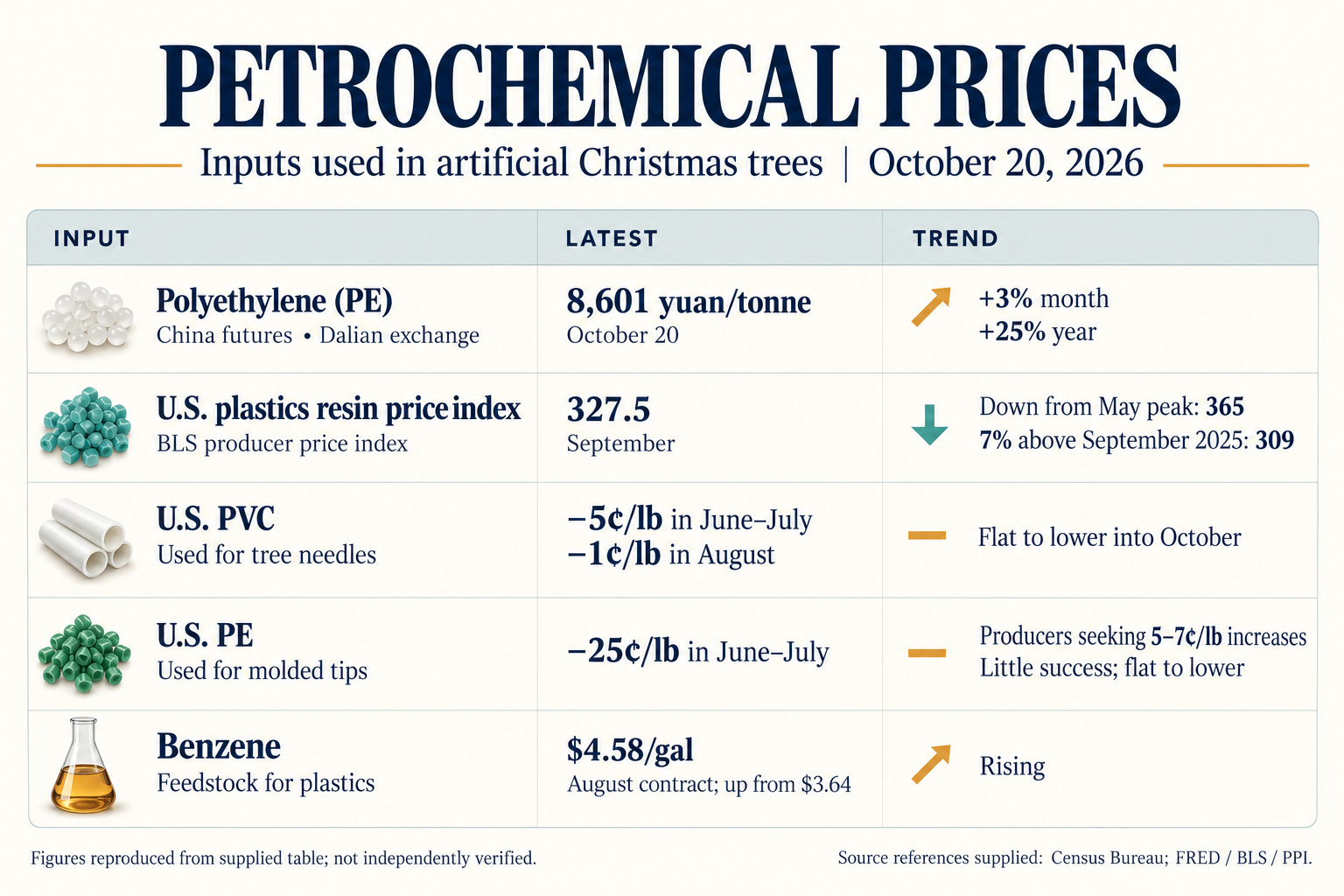
The strangling of trade at the Strait of Hormuz has impacted the volume of petrobased chemicals moving through that vital waterway.
Over 70,000 products are made with these chemicals. One of them is the Christmas tree.
An artificial Christmas tree is mostly PVC plastic film, molded polyethylene, steel wire, and a steel frame. “Pre-lit” trees, which now make up most of the market, include a full electrical system with associated costs.
Resin prices spiked in the spring (the resin price index jumped 17% from March to May, during the Middle East conflict). Prices have come down, but they are still higher compared to last year.
Here’s the supply chain of a Christmas tree:
1. Branches and “needles”
PVC (polyvinyl chloride) film: the traditional flat, papery needles. Rolls of colored PVC sheet are cut into thin fringed strips and twisted around a wire.
PE (polyethylene) molded tips: the realistic needles on higher-end trees, injection-molded from real branch casts. Most premium trees mix PE tips on the outside with PVC filler inside.
Steel wire: the core of every branch tip, so it can be bent and shaped.
Colorants, UV stabilizers, and flame-retardant additives mixed into the plastic.
2. Frame and structure
Steel center pole, usually in two to four sections, painted or powder-coated.
Steel branch arms and hinges so the branches fold (“hinged” trees).
Stand: a folding steel base or a molded plastic stand.
Small parts such as rivets, plastic hinge rings, and connectors.
3. Lights (pre-lit trees)
LED bulbs, or incandescent mini-lights on cheaper trees.
Copper wire harnesses and plugs.
Transformers or power adapters, controllers, and remotes for color-changing and “smart” trees.
Pole connectors that pass power through the trunk sections.
4. Finishes and extras
Flocking (“snow”): cellulose or synthetic fiber sprayed on with adhesive.
Pine cones, berries, and glitter (plastic, foam, or natural material).
Packaging: corrugated boxes, plastic bags, and printed inserts.
Butler explained the IEEPA tariff refunds have helped the company avoid passing on these higher raw material costs, along with soaring logistics prices and tariffs to its customers.
“We’re managing our costs very tightly to ensure that we can give consumers the affordability that they’re asking for,” said Butler.
Next season, however, pricing is cloudier.
The company is starting to place early orders for Christmas 2027 now, and in January, ahead of the Chinese New Year (February 6, 2027), for its bulk orders.
“At that point we'll really have a look at where raw material costs are and make some decisions on how much we want to bring in and how much we're going to sell to others,” said Butler. “We’ll then have to decide what pricing actions we need to take, if any. Hopefully, we won't. But we'll have to make those decisions then. But for right now, it’s very difficult, just purely because of the unknown.”